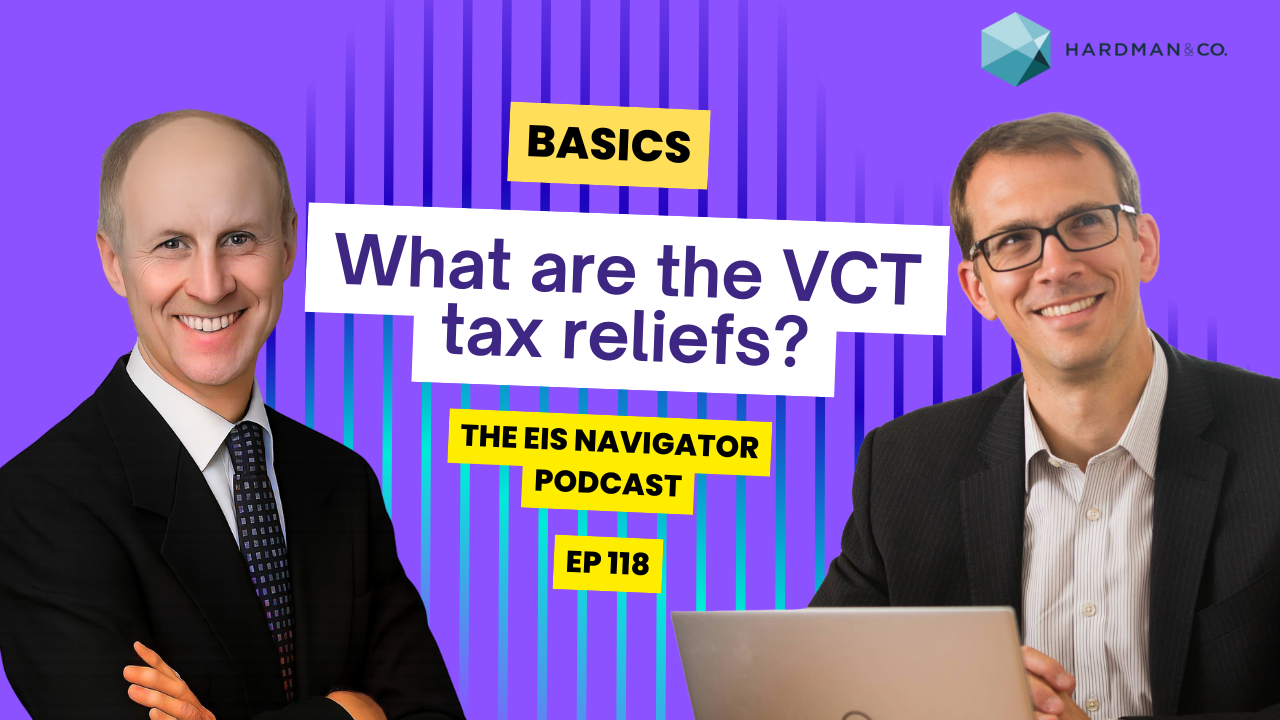
In the fourth of the EIS and VC Basics mini-series for The EIS Navigator, we discuss Venture Capital Trust (VCT) tax reliefs. Mercia manages the three Northern VCTs, so we asked their Head of Sales and Private Investor Relations, Paul Mattick, to come on and explain how they work. VCTs are the most popular of the tax advantaged schemes, so it’s great to get someone with such deep knowledge to explain the reliefs.
The topics we cover in the discussion include:
Note: after the recording, many of the individual company limits were doubled in the 2025 budget. The rate of Income tax relief was also cut from 30% to 20%.
As well as explaining the reliefs, Paul brings in a few important nuances, which will help many investors. Enjoy!
Never miss an episode – click here to subscribe to The EIS Navigator on most popular services.
Learn about Venture Capital Trusts on the HMRC website.
Read about tax reliefs for venture schemes on the HMRC website.
Check out the Mercia Asset Management website.
Dr Paul Mattick is Head of Sales and Private Investor Relations for the Mercia EIS Funds and VCTs. He works directly with private clients and advisers to build the EIS fundraising capacity of Mercia. Paul oversees the administration and development of the EIS funds, and ensures that investors receive a high level of service, much of which is delivered through Mercia’s award-winning Investor Centre. Paul has a variety of experience in early-stage businesses (including being a founder), and formerly worked at another leading EIS fund manager, where he built close relationships with top tier clients, and significantly grew both fund and single company assets under management. Paul has a PhD and Post-Doctorate from the University of Oxford and a 1st Class Bachelor of Science from the University of Leeds.
Q: What is the main income tax relief available through VCTs?
Investors receive 30% income tax relief on the amount invested, similar to EIS. However, there are some important differences:
Q: Is there a maximum amount that can be invested in VCTs each year?
Yes. The maximum qualifying investment is £200,000 per tax year. The minimum investment varies by offer but is typically £3,000–£6,000. Many high-net-worth investors invest the maximum annually, building up significant VCT portfolios over time.
Q: How long do I need to hold VCT shares to retain the tax relief?
You must hold the shares for at least five years. If you sell before then, the income tax relief will be clawed back. Unlike EIS, where each company’s holding period is separate, with VCTs the five-year period applies to the VCT shares themselves, which you can usually sell back to the VCT after that time.
Q: Can I split my investment between tax years?
Some VCT offers allow you to invest across two tax years if the offer remains open, allocating part of the investment to the current year and part to the next. However, popular VCTs often sell out quickly, so not all offers provide this flexibility
Q: Are VCT dividends taxable?
No. Dividends from VCTs are tax free – there’s no income tax or capital gains tax on them. This is a major attraction for investors seeking income. Typical dividends are around 5% per annum, often split between interim and final payments. When compared with taxable dividends from listed shares, this can be equivalent to a gross yield of around 12%, depending upon an investor’s tax rate.
Q: How are dividend strategies typically structured?
Established VCT managers generally pay:
Q: Are capital gains on VCT shares taxable?
No. Capital gains on the sale of VCT shares are exempt from Capital Gains Tax (CGT). While EIS can produce large individual company gains, VCT portfolios typically generate steadier, lower-risk returns, but all gains within the VCT structure are tax free.
Q: How do VCTs compare to EIS from a tax perspective?
Similarities: Both offer 30% income tax relief and CGT exemption on growth.
Differences:
Please email [email protected] if you have any questions or comments on The EIS Navigator.
Please note this podcast/interview does not constitute a financial promotion and is provided for informational purposes and should not be construed as an invitation or offer to buy or sell any investments. Please be aware that investments into unquoted companies are high risk, long term and illiquid investments. Your capital is at risk. Past performance is not a reliable indicator of future performance. Target returns are not guaranteed and forward looking statements are illustrative only and must not be relied upon. Investors should only invest on the basis of reading the full offer documentation. Listeners must make their own independent decisions and obtain their own independent advice regarding any information, projects, securities, tax treatment or financial instruments mentioned herein.