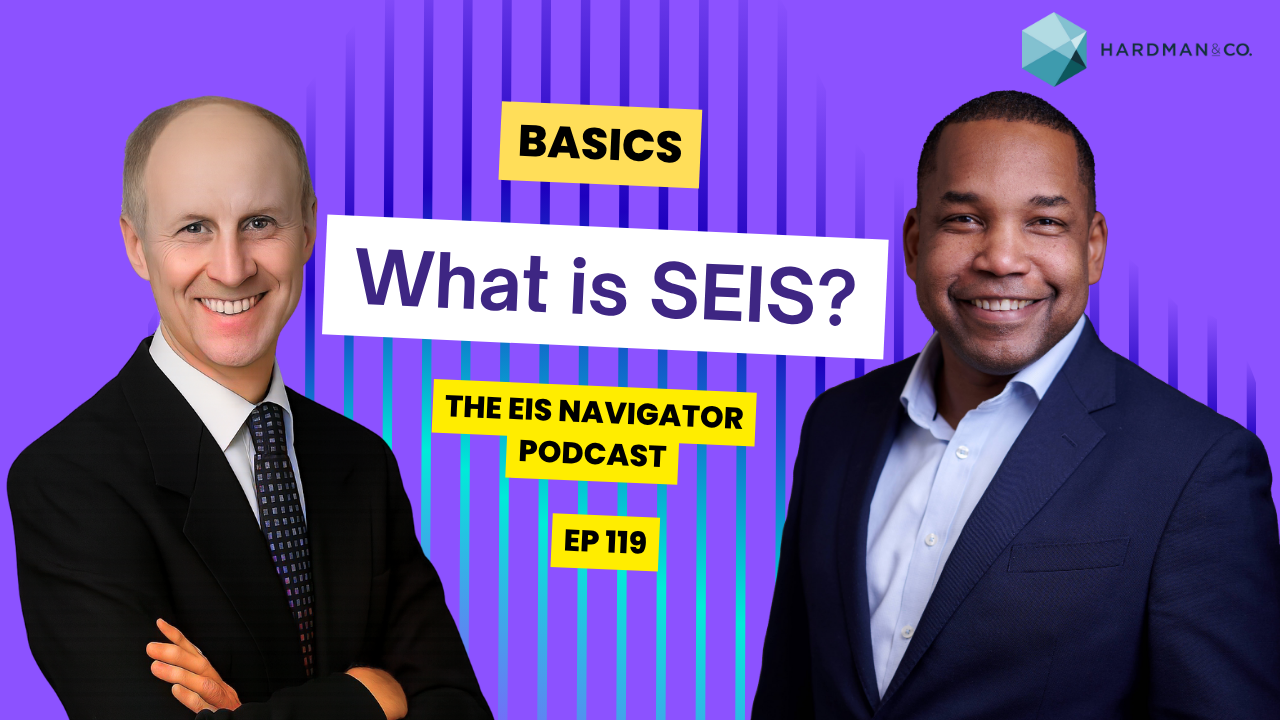
In the fifth of the EIS and VC Basics mini-series for The EIS Navigator, we discuss the Seed Enterprise Investment Scheme (SEIS). Jenson Ventures is one of the longest-standing SEIS managers, and Jeffrey Faustin has been with them for over a decade so has lots of knowledge to share about the scheme. Jeffrey gives a good introduction to SEIS, covering what an investor needs to get started.
The topics we cover in the discussion include:
Watch out for the next episode, which covers SEIS tax reliefs. Enjoy!
Never miss an episode – click here to subscribe to The EIS Navigator on most popular services.
Learn about the SEIS scheme on the HMRC website.
Read about the tax relief schemes for venture trusts on the HMRC website.
Check out the Jenson Ventures website.
Jeffrey Faustin is Managing Partner and Chief Investment Officer at Jenson Ventures with overall responsibility for the investment strategy and portfolio management of the fund’s investments. With over 10 years of experience in venture capital, he has worked with over 150 early-stage high-growth technology companies across all sectors, working with management teams to deliver growth through business strategy and board advisory support.
Q: What is SEIS?
The Seed Enterprise Investment Scheme (SEIS) was launched by the UK government in 2012 to encourage investment into very early-stage, high-risk startups. Because these companies often struggle to attract funding, SEIS offers generous tax reliefs to investors who are willing to take that early risk.
Q: How does the government ensure that companies are receiving genuine new money under SEIS?
There are strict rules. Companies must:
In addition, directors generally can’t invest under SEIS, and the shares must be unquoted — typically not listed on AIM or other exchanges.
Q: What kinds of companies typically qualify for SEIS investment?
These are very early-stage businesses, often pre-revenue or just starting to generate income. They span a wide range of sectors from AI and tech to consumer products. While fund managers often focus on high-growth, capital-efficient businesses, SEIS is designed to support a broad mix of early-stage ventures.
Q: Is SEIS mainly for technology companies?
Not necessarily. While many SEIS investments are in tech because of their growth potential, the scheme also supports product-based, retail and other types of businesses. It’s a tool to help all kinds of early-stage companies access capital.
Q: If an investor wants to invest in SEIS companies, what are their options?
Investors can participate in several ways:
Q: How do SEIS funds typically operate?
At Jenson, we raise funds quarterly and deploy capital into a selection of early-stage companies. We review thousands of business plans each year and follow a structured, repeatable process for screening and investing. Each fund, or ‘tranche’, is usually deployed within the same tax year it is raised, although some funds follow different timelines.
Q: How and when do investors typically see a return from SEIS investments?
SEIS investments must be held for at least three years to retain tax reliefs but, realistically, investors should expect a holding period of five to seven years, and often longer (up to 10 years). Returns usually come through the sale of the company rather than an IPO. Some SEIS shares may also be bought out in later funding rounds.
Q: What are the risks involved, and how are they managed?
Not all SEIS companies succeed: some will fail, often within a few years. That’s why diversification through a fund is important. The scheme offers loss relief, allowing investors to recover part of their investment if a company fails, which helps offset the inherent risks.
Please note this podcast/interview does not constitute a financial promotion and is provided for informational purposes and should not be construed as an invitation or offer to buy or sell any investments. Please be aware that investments into unquoted companies are high risk, long term and illiquid investments. Your capital is at risk. Past performance is not a reliable indicator of future performance. Target returns are not guaranteed and forward looking statements are illustrative only and must not be relied upon. Investors should only invest on the basis of reading the full offer documentation. Listeners must make their own independent decisions and obtain their own independent advice regarding any information, projects, securities, tax treatment or financial instruments mentioned herein.