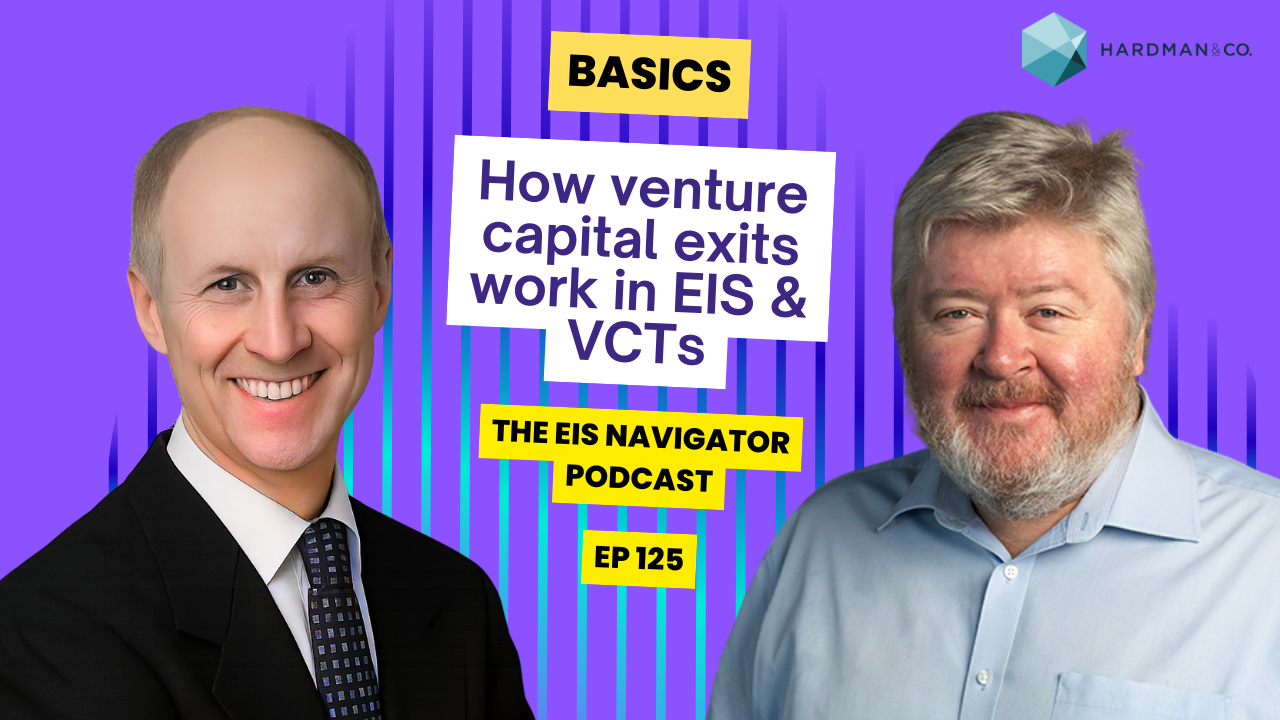
In the last episode of the EIS and VC Basics mini-series for The EIS Navigator, we discuss exits and why they matter to investors. Symvan Capital is building a track record of successful exits. Co-founder Kealan Doyle also has prior experience in capital markets so has lots of knowledge of the different kind of exits, as well as some of the wrinkles that investors need to watch out for.
Kealan covers all the different kinds of exits that an investor might come across. These include:
Kealan has had some unusual exit experiences in the past couple of years, so has some interesting examples to throw into the mix. Enjoy!
Never miss an episode – click here to subscribe to The EIS Navigator on most popular services.
Read about the tax relief schemes for venture trusts on the HMRC website.
Check out the Symvan Capital website.
Kealan Doyle, Co-founder and CEO of Symvan Capital led a structured equity products team at HSBC, where he was responsible for developing and managing innovative investment solutions before co-founding Symvan Capital and moving into venture capital investing. Kealan holds degrees from the London School of Economics and the University of Toronto and his earlier career included roles at Deutsche Bank, Merrill Lynch and UBS, where he gained extensive experience in capital markets and complex financial products. For over 20 years, he has worked closely with venture capital-backed businesses, initially in a corporate finance advisory capacity and, more recently, as a fund manager. This dual perspective has given him a deep insight into the challenges early stage companies face and how best to support their growth and long-term success.
Q: Why are exits so important in EIS and SEIS investing?
Exits are ultimately how investors realise value. Although EIS/SEIS can be the highest-performing part of a portfolio, they are illiquid asset classes. Without exits, investors are simply left holding an illiquid asset indefinitely. Regular exits – whether small or large – are essential to delivering returns.
Q: How long does it typically take for a company to reach an exit?
While unpredictable, the average expected life is around seven years. Some companies exit earlier, while others take much longer. Kealan notes an example that took eight-and-a-half years, and another recent exit where SEIS investors exited after five years.
Q: Do failures count as exits?
Yes. Failures are a form of exit, and investors must expect some. The generous tax incentives exist precisely because early-stage venture investing carries failures. A manager’s real track record should be judged on cash in versus cash out, not simply on the number of successful exits.
Q: What is a typical failure rate in venture capital?
Many venture funds experience failure rates of 50% or more. Symvan Capital claims a rate of less than 10%, which is low by market standards, but good exits are still necessary to offset any losses.
Q: What is a trade sale?
A trade sale is when a company is sold to another, usually larger, business in a related industry.
Q: What do investors receive in a trade sale – cash or shares?
It can be either or both: cash, which gives an immediate realised return, or shares in the acquiring firm, which could be listed (and therefore liquid) or unlisted (which may create another period of illiquidity). Sometimes structuring is required to manage EIS three-year rules and avoid creating unwanted tax liabilities.
Q: What is a secondary sale?
A secondary sale allows early investors to sell their shares to a new investor without a full company sale or IPO. These often occur during funding rounds when a new investor wants a larger stake than is available through primary issuance.
Q: Are secondary sales common?
They remain relatively uncommon at the early-stage end of the market but are increasing slowly. Stock exchanges and other private-market platforms are working on improving liquidity for venture-backed companies.
Q: What about initial public offerings (IPOs)?
IPOs are another exit route, but the UK IPO market – especially AIM – is far less active than in the 2000s. Many founders now look towards NASDAQ instead, attracted by higher valuations and deeper liquidity. Biotech remains one of the few sectors where AIM is still a viable option.
Q: What should investors look for when assessing a manager’s exit track record?
Q: How significant are the tax benefits when an exit occurs?
They’re an essential part of the return. Gains on EIS/SEIS shares are tax-free after three years, which can materially boost post-tax performance compared with listed equities. Even an early exit at 2× or 3× can generate an attractive outcome once tax relief is factored in.
Please note this podcast/interview does not constitute a financial promotion and is provided for informational purposes and should not be construed as an invitation or offer to buy or sell any investments. Please be aware that investments into unquoted companies are high risk, long term and illiquid investments. Your capital is at risk. Past performance is not a reliable indicator of future performance. Target returns are not guaranteed and forward looking statements are illustrative only and must not be relied upon. Investors should only invest on the basis of reading the full offer documentation. Listeners must make their own independent decisions and obtain their own independent advice regarding any information, projects, securities, tax treatment or financial instruments mentioned herein.