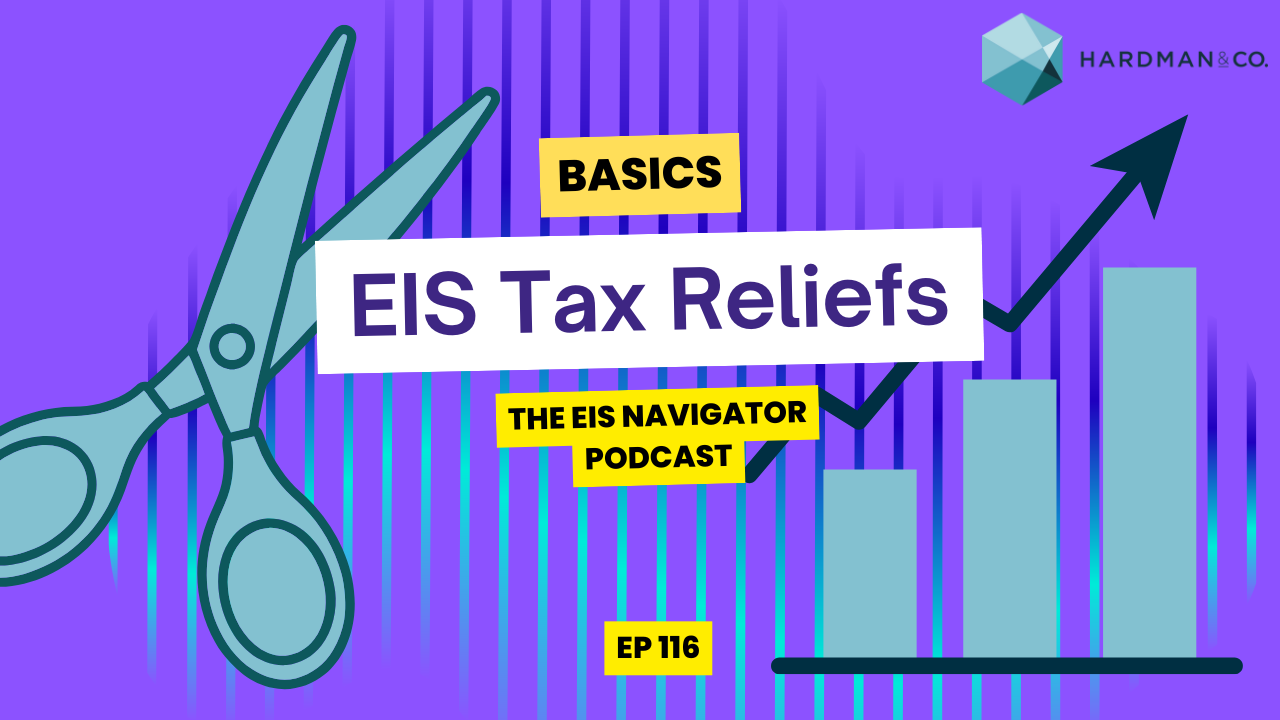
This is the second in the new EIS and VC Basics mini-series for The EIS Navigator.
This episode follows on directly from episode one and we go into the tax reliefs that are available on investments using the Enterprise Investment Scheme (EIS). For many investors, these are one of the main attractions of the scheme and the reliefs are amongst the most generous in the world. Remember, video is also available alongside the Hardman Talks videos on the Hardman & Co YouTube Channel so check them out there.
In this episode, host Brian Moretta flies solo, giving a run through of the reliefs. These include:
As well as explaining the reliefs, Brian brings in lots of examples. Enjoy!
Never miss an episode – click here to subscribe to The EIS Navigator on most popular services.
Learn about the Enterprise Investment Scheme on the HMRC website.
Find out about the tax reliefs for investors using venture capital schemes on the HMRC website.
Brian Moretta is the Head of Tax-Advantaged Research at Hardman & Co, and also covers Financials stocks and Investment Funds. In addition to his role with Hardman & Co, Brian is an Honorary Fellow at Heriot-Watt University, where he lectures on actuarial science and financial economics. He has also been an examiner for the Faculty & Institute of Actuaries. Brian has had a 25-year career in Financial Services, including more than a decade as a fund manager. He specialised in analysing financial services companies at SVM Asset Management, as well as managing two traded endowment funds and an equity fund, and working on hedge funds. He has also been a Trustee and Board Member for Scouts Scotland. Brian joined Hardman & Co in 2013. A qualified actuary, he holds a PhD in Applied Probability and a BSc in Actuarial Maths and Statistics from Heriot-Watt University.
Q: What is the Enterprise Investment Scheme (EIS)?
The EIS is a UK government programme that encourages investment in early-stage, high-growth companies through tax reliefs. It helps innovative businesses raise funding while giving investors exposure to a higher-risk asset class.
Q: Do I need professional advice before claiming EIS tax reliefs?
A: Yes. While this FAQ outlines the key features, applying the reliefs can be complex. It’s strongly recommended that you speak to a financial adviser or tax professional to ensure the reliefs are used correctly for your personal circumstances.
Q: How much income tax relief can I claim on an EIS investment?
A: You can claim 30% income tax relief on investments of up to £1 million per tax year. This can rise to £2 million if at least £1 million is invested in knowledge-intensive companies.
Q: How does the relief work in practice?
A: If you invest £10,000 in an EIS-qualifying company or fund, you can offset £3,000 (30%) against your income tax bill for that year.
Q: What if my investment is made near the end of a tax year?
A: The relief applies to the tax year in which the investment is made, not when you pay the money. For example, if you invest in March but the fund deploys capital in the following tax year, the relief applies to that later year.
Q: Can I carry back EIS income tax relief to a previous year?
A: Yes. You can carry back the relief to the previous tax year, or even split it between the two years, up to the annual investment limit.
Q: Is there a minimum holding period for income tax relief?
A: Yes. You must hold the investment for at least three years. If you sell before that period, you will have to repay the income tax relief in full, even if the sale is just a few days short of three years.
Q: Can I defer capital gains by investing through EIS?
A: Yes. If you have a capital gain from any source (e.g. selling property or shares), you can defer the capital gains tax by reinvesting that gain into an EIS investment. The tax is deferred until the EIS investment is realised.
Q: Is there a time limit for reinvesting the gain?
A: There’s a reasonably wide time window, but the exact rules can be technical. It’s best to check the current HMRC guidance or consult a tax adviser.
Q: What happens if my EIS investment loses money?
A: You can claim loss relief against income tax or capital gains tax. The relief applies to the net cost of the investment (i.e. after income tax relief).
Q: Can you give an example of loss relief?
A: If you invest £10,000 and claim £3,000 income tax relief, your net cost is £7,000. If the company fails, you can offset the £7,000 loss against your tax bill. For a 40% taxpayer, that’s a further £2,800 in tax relief, meaning your effective loss is only £4,200, or 42p in the pound.
Q: Are EIS dividends tax-free?
A: No. Unlike some other tax-advantaged schemes, EIS does not offer any dividend tax exemption. In practice, most EIS investments are in early-stage companies that are unlikely to pay dividends for many years.
Q: Do EIS investments qualify for inheritance tax relief?
A: Yes. EIS shares qualify for Business Relief, making them either fully or partially exempt from inheritance tax, subject to current rules.
Q: Have there been recent changes to inheritance tax relief?
A: Yes. The 2024 Budget announced that full business relief will apply to the first £1 million of qualifying assets, with a 20% relief rate on amounts above that. Shares listed on AIM or certain markets may not benefit from the full exemption.
Please email [email protected] if you have any questions or comments on The EIS Navigator.
Please note this podcast/interview does not constitute a financial promotion and is provided for informational purposes and should not be construed as an invitation or offer to buy or sell any investments. Please be aware that investments into unquoted companies are high risk, long term and illiquid investments. Your capital is at risk. Past performance is not a reliable indicator of future performance. Target returns are not guaranteed and forward looking statements are illustrative only and must not be relied upon. Investors should only invest on the basis of reading the full offer documentation. Listeners must make their own independent decisions and obtain their own independent advice regarding any information, projects, securities, tax treatment or financial instruments mentioned herein.