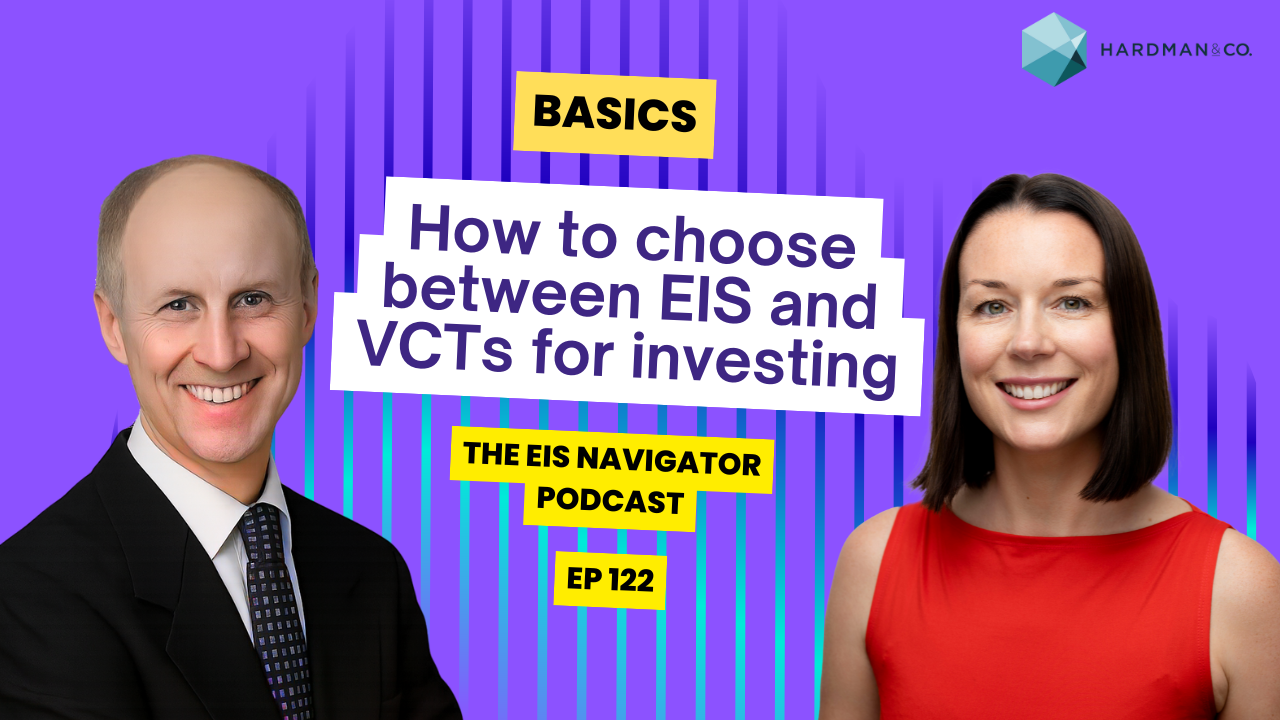
In the latest episode of the EIS and VC Basics mini-series for The EIS Navigator, we discuss how investors should choose between EIS and VCTs. Calculus Capital manages products under both schemes, so its Head of Investor Relations, Francesca Rayneu, is ideally placed to discuss the arguments for both.
Francesca covers lots of different areas that may need to be considered. These include:
While we cover a lot of areas, investors may wish to take financial advice to see how each applies to their own situation. You may wish to listen to or watch episodes 113 to 116 before this if you are less familiar with the schemes. Francesca gives a good explanation of what investors should think about. Enjoy!
Never miss an episode – click here to subscribe to The EIS Navigator on most popular services.
Read about the tax relief schemes for venture trusts on the HMRC website.
Check out the Calculus Capital website
Francesca Rayneau, Head of Investor Relations at Calculus Capital, joined Calculus in 2015 and leads the Sales and Marketing team, overseeing all aspects of fundraising, marketing and investor communications. She began her career in financial services in Geneva, Switzerland. She holds a degree in International Management from the University of Manchester, during which she also studied at Bocconi University in Milan. Francesca has also earned the CISI Certificate in Wealth Management and the Client Assets and Money qualification.
Q: What are the main differences between EIS and VCTs?
Although both schemes aim to channel private capital into early-stage UK businesses, they’re structured differently.
Q: How should an investor begin choosing between EIS and VCTs?
Start with three key considerations:
Q: What types of investors typically choose VCTs?
Traditionally, VCT investors were older, often pre-retirement or retired, looking for tax-efficient income through tax-free dividends. Recently, the demographic has been getting younger as high-earning professionals face rising tax burdens and want tax-efficient income streams.
Q: What types of investors typically choose EIS?
EIS tends to appeal to entrepreneurial types or those deeply interested in early-stage companies and specific sectors such as tech, life sciences or climate innovation. Investors often already hold broader venture exposure and want more targeted or higher-risk/higher-return opportunities.
Q: How do liquidity and time horizons differ between EIS and VCTs
Q: How do the tax reliefs differ?
Q: Why might advisers favour one product over the other?
Some advisers prefer the relative simplicity and predictability of VCT dividend streams; others value the broader tax-planning versatility of EIS. Many conclude that using both together—VCTs for core exposure and EIS for targeted growth or tax planning—offers the best blend.
Q: How do investment strategies differ across managers?
EIS managers often specialise—tech, healthcare, climate tech, deep science, etc.—giving investors a wide choice of niches. VCT strategies tend to be later-stage relative to EIS and are more focused on maintaining diversified portfolios that support reliable dividends.
Q: What should investors look out for when comparing fees?
Because early-stage investing is hands-on, fees are higher than in conventional funds. Important considerations include:
Please note this podcast/interview does not constitute a financial promotion and is provided for informational purposes and should not be construed as an invitation or offer to buy or sell any investments. Please be aware that investments into unquoted companies are high risk, long term and illiquid investments. Your capital is at risk. Past performance is not a reliable indicator of future performance. Target returns are not guaranteed and forward looking statements are illustrative only and must not be relied upon. Investors should only invest on the basis of reading the full offer documentation. Listeners must make their own independent decisions and obtain their own independent advice regarding any information, projects, securities, tax treatment or financial instruments mentioned herein.