This article is based on a speech on the subject “Minority Sports – Small Business Financing”, which the author gave in March of this year at the “Weekend of Mistakes” event in Hay on Wye.[1]
It is now exactly 10 years since Hardman & Co published The Gifford Report: Two questions every growth company management should ask themselves. This paper sought to answer two straightforward questions: “Who will our next investors be?” and “What will they expect from us?”
At the time of writing that paper, the environment for funding businesses was evolving. In the 10 years since publication, the landscape for funding smaller businesses, in particular, has changed dramatically.
This article will be of interest to founders, owners and managers of businesses, as well as investors.
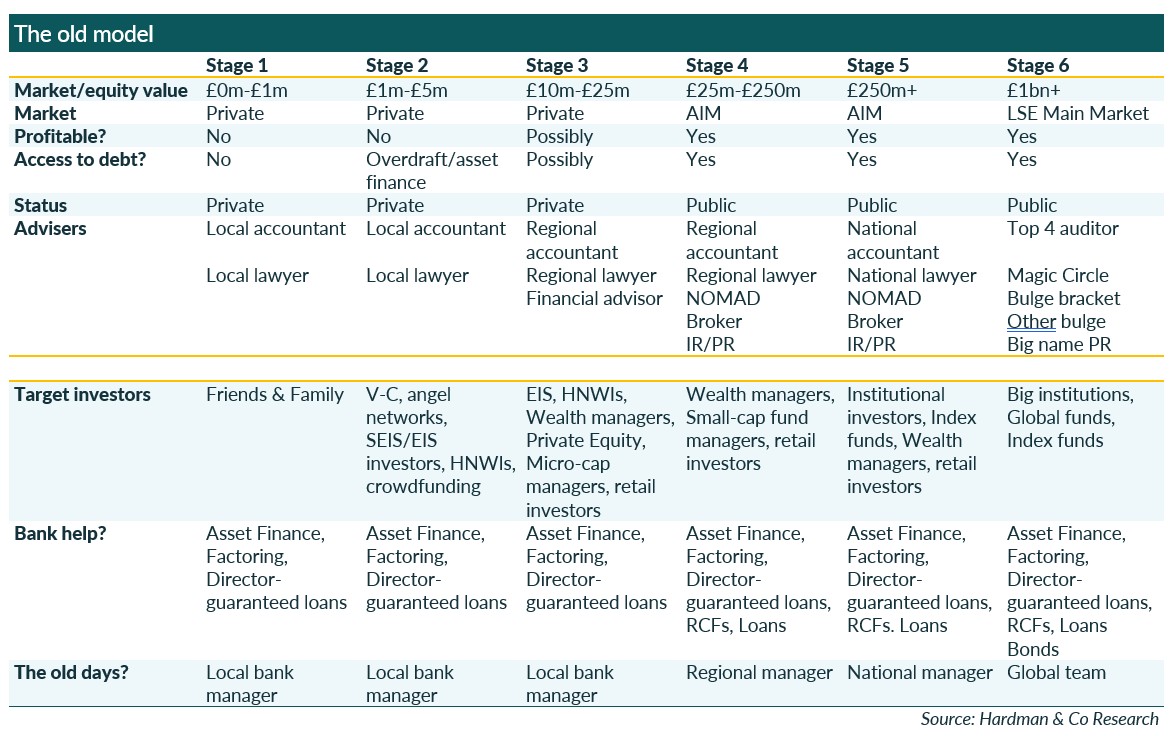
The table below sets out the world of funding as it used to be. When was this “golden” period? Probably, more than 25 years ago would be a reasonable guess.
The table demonstrates that as a company grows in scale (we are using capital required here, rather than turnover):
Broadly, the journey starts with friends and family and ends with global investors. In the early stages, the Captain Mainwarings[2] of the world would have been important; the local bank manager had real discretion over lending as well as being a pillar of local society! He would know all the local businesses, and had discretion over lending to them. The role and status of the local bank manager have changed dramatically, and judgments regarding lending decisions to smaller companies have been replaced by automated decisions.
The situation today is very different, as shown in the table below:
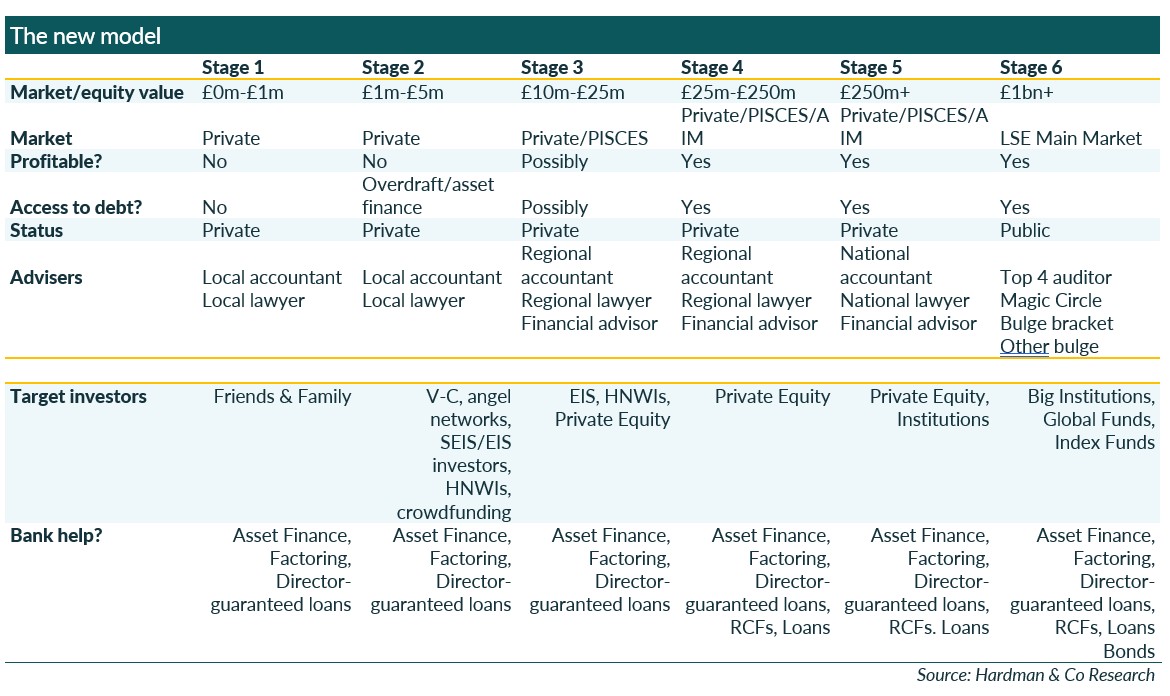
The beginning and end of the funding journey has not changed a great deal, apart from the loss of the local bank manager. It is the stages in between that are very different today.
Traditionally, a flotation on the stock market was a step on the road to greatness. Today, typically, companies come to the public markets later in their journey. The average market capitalisation of an IPO (initial public offering) on AIM (the Alternative Investment Market) was £21m in 1995; by 2020, that figure had risen to £127m.[3] This development has resulted in a substantial shrinkage in the number of public companies on the London market. Between 2007 and 2020, the number of companies trading on the Main Market of the London Stock Exchange shrunk by 25%, and those on AIM by 50%.[4] The same story has been seen on most stock exchanges around the world.
The role of public markets in the middle of the funding journey has been substantially usurped by private equity. There are many reasons why companies go public later in their journey. However, the four key ones are:
A fifth reason for companies to delay “going public” is emerging. There have always been platforms where private company shares can be traded occasionally. However, the FCA launched an initiative, in June 2025, to give this space more legitimacy and comfort for investors ‒ PISCES (Private Intermittent Securities and Capital Exchange System). There are already four approved platforms under this imitative: Asset Match; JP Jenkins; London Stock Exchange; and Vestd. Further details are set out below.[5] In the past few weeks, these platforms have raised money for Wayve, the British autonomous driving technology company[6] and announced a transaction for Moneybox, a London-based fintech,[7] (a trade that raised £45m in an employee share sale, valuing the whole company at £800m). The PISCES platforms may become a stepping stone in a company’s path to becoming a mega-cap.
We should also note how much more important the Enterprise Investment Scheme (EIS) has become since its launch in 1994.
The two tables above show that each stage in a company’s life appeals to a different sort of funder or investor. Size is an important part of the choice for nearly all investors. Many tend to specialise in a specific range of sizes. There are also other factors that investors take into account, such as:
When an investor is considering an opportunity, they will have in their mind a list of questions they want answered. The set of questions an early-stage investor asks will be completely different to those posed by “buy and build” investors.
Hardman & Co has worked with many companies to prepare them for fund raising and sale. In our experience, founders and mangers struggle with the following:
In a sense, owners and managers can be excused for not knowing these things, because their expertise lies in running their business, not talking to investors or valuing businesses.
The new small business funding environment has implications for investors as well, particularly retail investors.
Since, typically, companies come to the public markets later in their life and stay in the hands of private equity for longer, it is more difficult for retail investors to participate. These investors can only get access to PE investments through specialist funds, such as specialist investment companies. This can mean that, not only do they miss out on particular companies, but whole sectors may be in the hands of PE and unavailable to retail.
The EIS scheme and its little brother, the Seed Enterprise Investment Scheme, have been a great success in funding early-stage companies in the UK. The Enterprise Investment Scheme Association, the industry body, asserts that “SEIS and EIS have together facilitated £35.5 billion of private investment into more than 62,000 businesses. These businesses generated £28.2billion in turnover and employed 386,000 people in 2023 alone”.[8] However, not all retail investors can participate; investors need to meet certain criteria before being let in. Despite the success of the schemes, it is still surprising how small a percentage of those eligible actually take advantage of these opportunities.
For more information on EIS investing visit the Hardman & Co website.[9] Hardman & Co is a leading commentator on the EIS market.
The same restrictions apply to investors in the PISCES platforms.
EIS and PISCES are part of the reason why the UK is good at early-stage investing. Where the UK can lose out is on larger companies, where valuations put on companies by US markets can be substantially higher.
[1] You can view a recording of this speech here: https://hardmanandco.com/how-small-businesses-get-funded-keith-hiscock-weekend-of-mistakes/ The event website is here: https://www.weekendofmistakes.org/
[2] Captain Mainwaring was the leading character in the BBC comedy, Dads Army, which covered the antics of a band of Local Defence Volunteers in a typical English seaside town during the Second World War. Mainwaring was the local bank manager in civilian life.
[3] See the paper jointly written by Hardman & Co and the Quoted Companies Alliance: Are the public markets closing to smaller companies?, pages 10 and 11, 1 May 2020, https://hardmanandco.com/research/corporate-research/are-the-public-markets-closing-to-smaller-companies/
[4] See the paper jointly written by Hardman & Co and the Quoted Companies Alliance: Are the public markets closing to smaller companies?, pages 5 and 6, 1 May 2020, https://hardmanandco.com/research/corporate-research/are-the-public-markets-closing-to-smaller-companies/
[5] FCA “PISCES: platforms for trading private company shares@ 27/4/26 https://www.fca.org.uk/markets/pisces-private-intermittent-securities-capital-exchange-system
[6] Employees of Wayve raised $85m through a transaction on the London Stock Exchange’s PISCES platform, valuing the whole business at $8.5bn.
[7] Moneybox is proposing a £45m employee share sale, valuing the whole company at £800m.
[8] https://www.eisa.org.uk/about-eis/facts-and-figures/
Keith Hiscock is the Chief Executive of Hardman & Co.
He is personally responsible for the firm’s relationships with its corporate clients and also for corporate finance. In addition, he is the author of several articles tackling the issues facing companies in today’s climate.
Keith has more than 45 years’ City experience and has developed long-standing relationships with many major institutional investors, including Private Client Brokers and Wealth Managers. He started his career at James Capel, at the time the top-ranked research house in London. He was a founding member of Schroder Securities and of Agency Partners, a leading research boutique house, and was a member of the five-man securities board at Evolution. Keith has also advised companies, large and small, on their relationships with the capital markets.
Keith was part of the group of investors that acquired Hardman & Co in late 2012. He holds an MA in Philosophy, Politics & Economics from the University of Oxford.