
For some years, there have been various IICs with a public quotation. Currently, eight maintain this status within the sector, with only the highly successful BBGI – the recipient of a favourable bid – recently being de-listed. All eight IICs, with the notable exception of Digital 9 Infrastructure, have held their own in a challenging investment environment, although 3i Infrastructure has outperformed its peers on several fronts, including dividend growth.
As the Government’s quest for clean energy took root, many REIFs were floated; most attracted substantial investment at their IPOs. Back in 2024, there were 22 quoted REIFs; although TRIG, among others, had been quoted for some years. Subsequently, some have been de-listed, including Asian Energy Impact (formerly ThomasLloyd Energy Impact), Atrato Onsite Energy and the renamed Hydrogen Capital Growth. Several others are currently in MWD – a process that, within the sector, only Triple Point Energy Transition has completed to date. In short, virtually all REIFs have faced challenges in seeking to increase their NAVs, especially as their putative access to capital markets has effectively been barred in recent years.
This note addresses recent developments among the eight IICs and the remaining 15 quoted REIFs. The ranks of the latter have thinned out of late, a process that seems set to continue.
The share price charts reproduced below, one for the IICs and one for the REIFs, show the current market ratings for the combined sector’s stocks. They indicate the latest NAV figures and the discounts, some considerable, at which they are trading. Also included are the prospective dividends and the relevant yields; in the latter case, many yields for the RECs are in double figures.
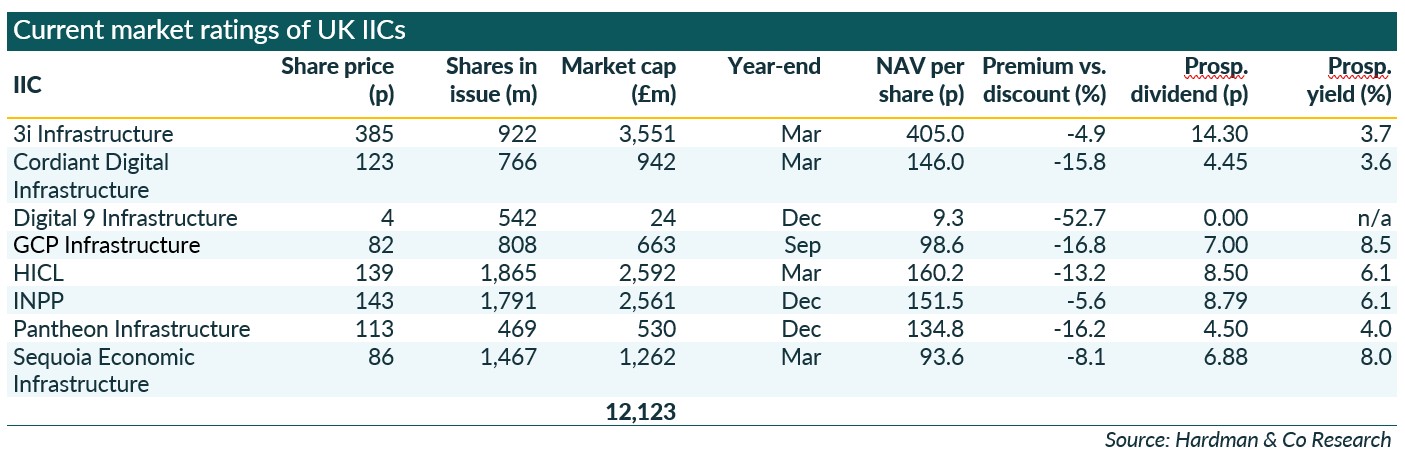
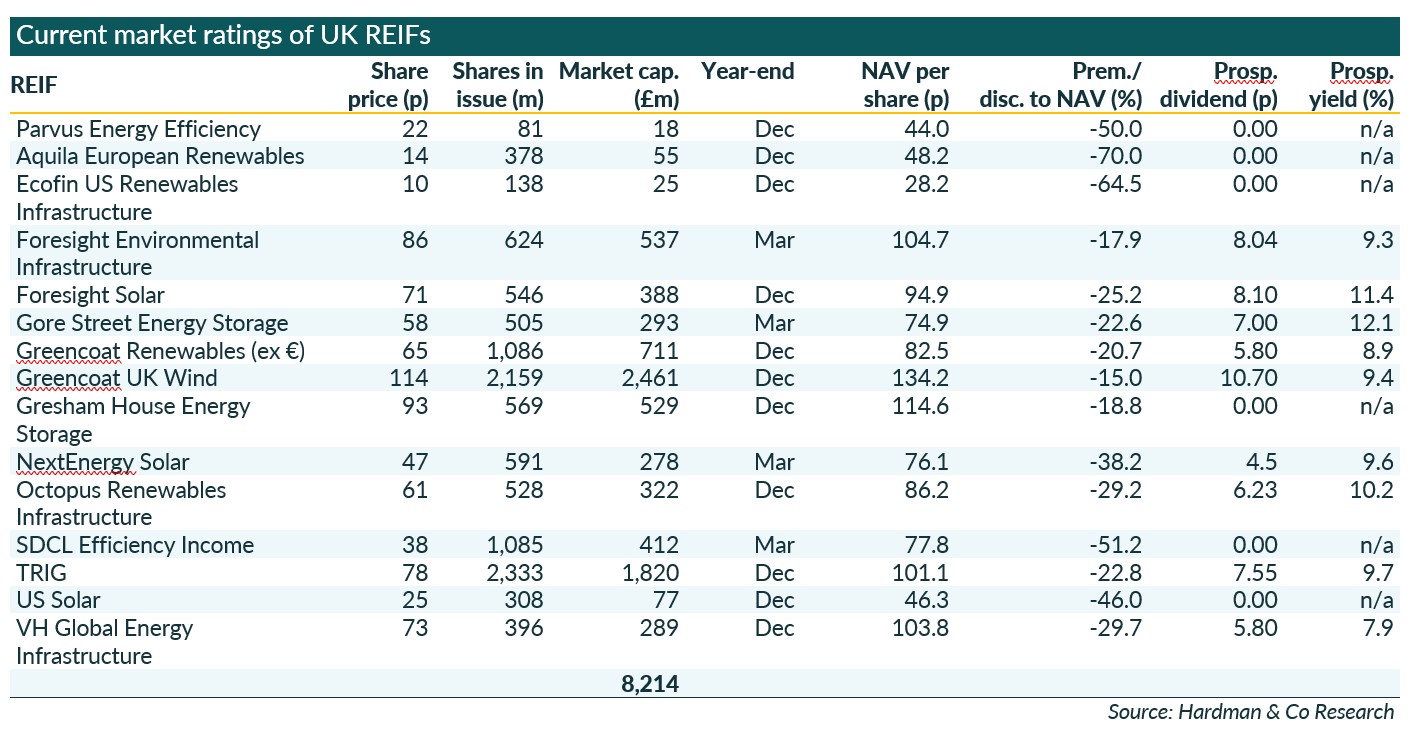
The table below shows how each stock performed between 9 February 2026 and 7 August 2026: there were some significant movements over the six months.
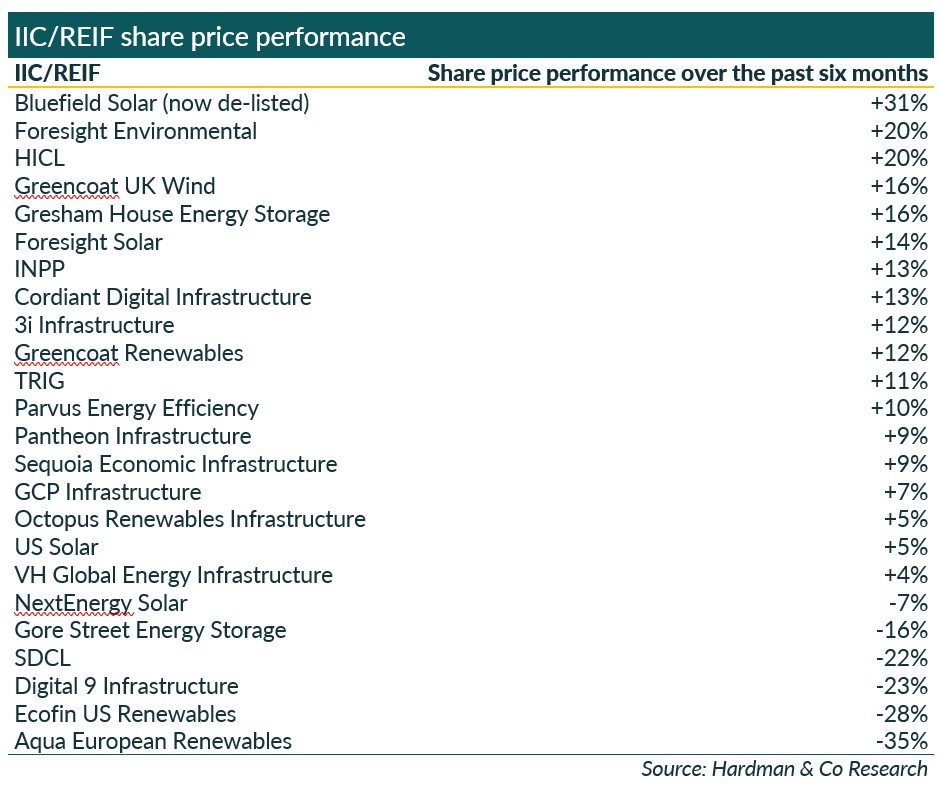
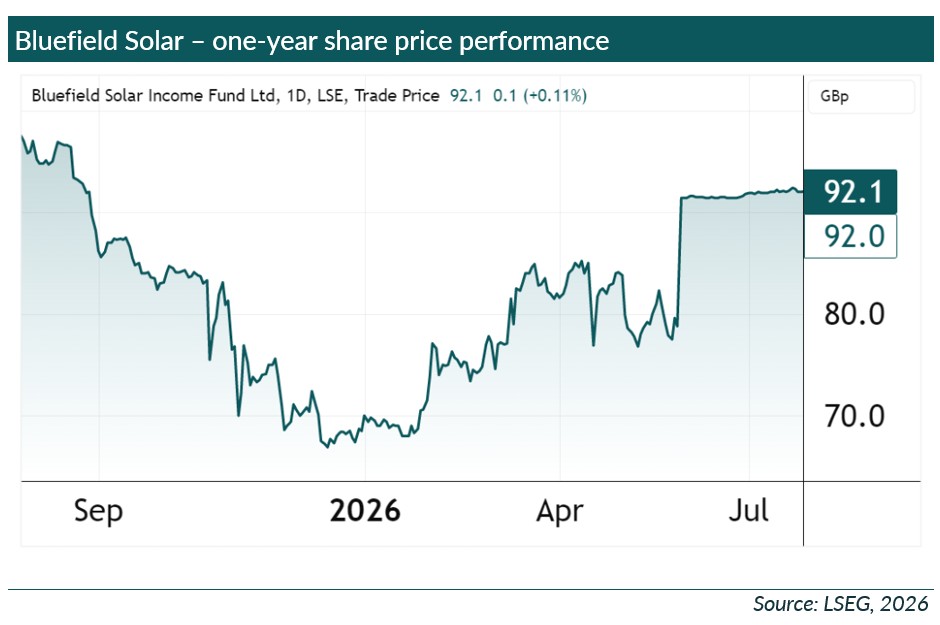
Among the IICs, decent share price performances were achieved by HICL, Cordiant Digital Infrastructure and INPP. And, within the REIF sector, investors in Bluefield Solar prospered following the agreed £561m bid from leading electricity generator, Drax Group – the cash price was 92.6p per share. The finances of the bidder and its target are both highly dependent on heavy government subsidies. It should be noted, too, that both Harmony Energy Income and Downing Renewables and Infrastructure were taken over in 2025.
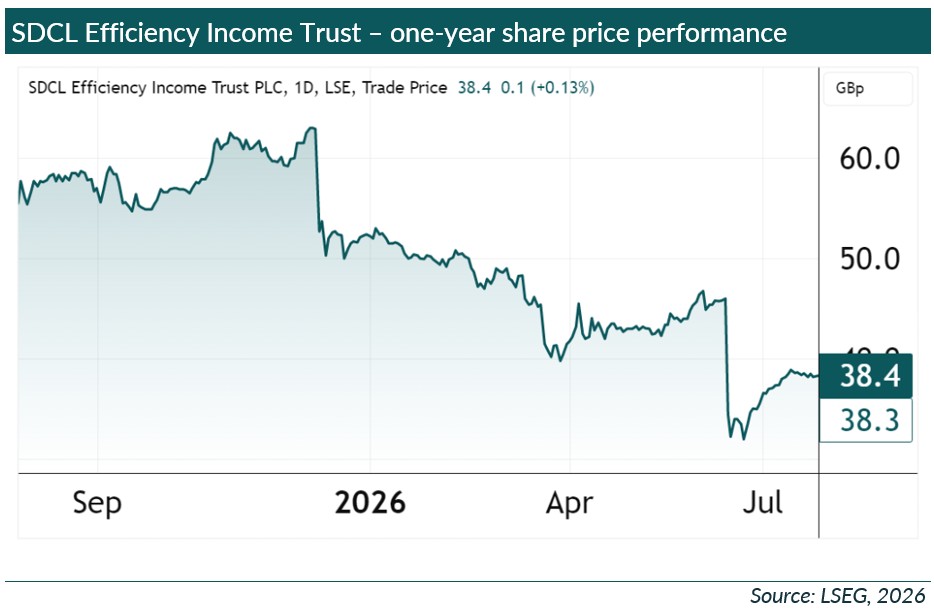
On the downside, Aqua European Renewables has faced real problems with specific assets, which lie at the heart of its MWD. SDCL, now in MWD, has also performed poorly, with a passed 4Q dividend and the recognition that realising an acceptable level of value from its complex portfolio of investments will be very challenging.
One-year share price graphs of the, now de-listed, Bluefield Solar and SDCL – experiencing markedly different share price performances over the period – are set out below.
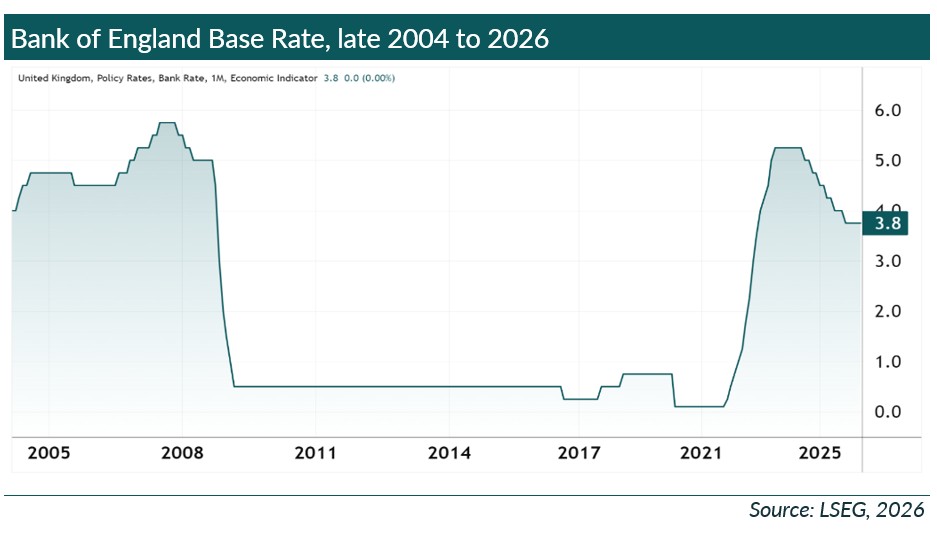
Valuations of both IICs and REIFs are heavily impacted by the level of UK interest rates. In recent years, interest rates have remained higher than anticipated, due in part to UK inflation – currently 2.6% – remaining quite sticky. At present, the UK base interest rate is 3.75%, and it is likely that it will rise to 4.0% and possibly higher. Much will depend on the resetting of government economic policy, especially the levels of borrowing, under new leadership.
The graph below shows how UK interest rates have moved since 2004.
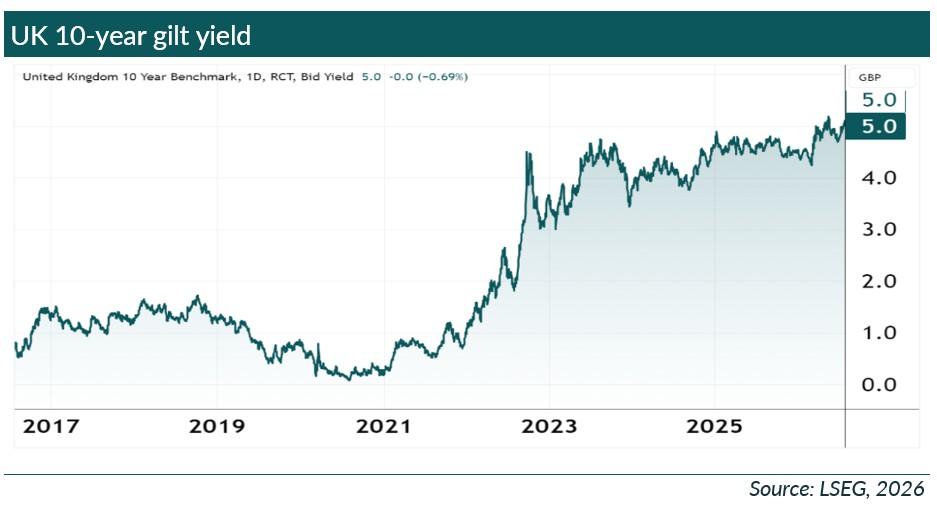
More specifically, movements in the 10-year gilt yield are a leading indicator. As political uncertainty has risen in recent months, long-term gilt yields have increased. While the new leadership of the Labour government has reasserted a firm commitment to its long-term borrowing criteria, there is no guarantee that these key financial targets will be achieved, especially given the seemingly unquenchable appetite for additional government expenditure. Of course, bond market vigilantes will follow carefully the impact of any shift in the government’s economic policy.
The graph below highlights the movements over the past decade in the yields of 10-year gilt-edged stock. Perhaps not surprisingly, the 10-year yield figure has been volatile of late, due partly to the machinations of the Labour Party leadership.
Prevailing interest rates are a key factor in determining the discount rates used, for valuation purposes, by IICs and REIFs. Higher interest rates, unless offset by other factors, will normally increase the discount rate and thereby lower the fund’s valuation. Assuming that the share price discount to NAV remains unchanged, this trend will inevitably depress the relevant share price.
Over the past two years, several IICs and REIFs have entered MWD, generally after an adverse vote from discontented shareholders. Only Triple Point Energy Transition has completed the arduous process: many others are aiming to liquidate their assets – and seeking to achieve proceeds that are as close as possible to the latest published NAV figure. The combined sector funds currently in MWD are:
Over the past six months, NAVs for the IICs – with a few exceptions – have been flat. Cordiant Digital Infrastructure has outperformed its peer group, with an NAV increase of 12.6% over the previous year. INPP has also seen some growth, as has HICL, which has – at last – committed itself to a progressive dividend policy.
Surprisingly, 3i Infrastructure, which has delivered so many profitable investments in the past, was forced to write off £220m from its DNS:NET telecoms business in Germany. It will not be the last UK telecoms business to meet serious turbulence in Germany – many others have done so in recent decades.
Also, on the downside, Digital 9 Infrastructure, now in MWD, continues to struggle to realise funds for its disillusioned shareholders. Its £459m investment in Arqiva, undertaken just four years ago, has now been written down to zero – an appalling loss of shareholder value for a relatively modest undertaking.
By and large, NAV increases for REIFs have been few and far between, with many reporting relatively flat NAV figures, which imply lower long-term dividend growth. Two REIFs have announced major falls in their NAV. Gore Street Energy Storage, after undertaking generous dividend payments arising from its US Investment Tax Credits (ITCs), then confirmed a 27% decline in its NAV, due mainly to lower merchant price projections for battery storage sales. SDCL also published a sharply lower NAV, down by 14% when compared with the previous year, as its recent entry into MWD provided a more incisive – and market-related – valuation of its assets.
Not surprisingly, yields for IICs are seemingly attractive, although allowance should be made for low dividend cover, which applies in several cases: the average unweighted IIC prospective yield, excluding Digital 9 Infrastructure, is close to 6%. In HICL’s case, its decision to announce its dividend policy until 2028 – with a target figure of 8.65p per share – is reassuring: it follows many years, dating back to 2018/19, of flat dividends. As expected, 3i Infrastructure continues to score well on the dividend front – with a projected 6.3% increase for next year to 14.3p per share.
The REIF dividend outlook is considerably less optimistic. Sector leader, Greencoat UK Wind, has pulled back its formidable dividend growth of late. It is now linking its future dividend payments to increases in CPI. Other REIFs have set out more modest targets. Octopus Renewables Infrastructure has adopted a dividend increase of just 1%, similar to the figure of Foresight Environmental Infrastructure but above TRIG’s held dividend. There have been some notable dividend cuts of late, including those of NextEnergy Solar and SDCL; the latter is now in MWD. In many cases, dividend cover is low, so further dividend cuts cannot be ruled out, especially for many REIFs.
The recent change in Prime Minister gives rise to different risk factors for the IICs and REIFs. Various shifts in policy have been widely discussed, but it is unclear – for the moment at least – which ones will materialise. Among the main issues affecting the IICs and REIFs are:
Aside from the obvious doubts about the quest for Net Zero, which – under the new government leadership – may give rise to substantial changes, there are several issues that specifically affect the REIFs.
The issue of how inflation is accounted for under the old ROC regime is very relevant to those REIFs who benefit from ROC-related payments. In the event, the government decided that a CPI-related upgrade was appropriate – to the evident relief of the more well-established REIFs. Indeed, Greencoat UK Wind has specifically cited the CPI-upgrade decision as a key factor in determining its revised dividend policy of CPI-linked annual increases.
Market prices are also a key valuation factor, especially when considerable emphasis is placed on merchant sales. This factor was central to the recent cut to the NAV of Gore Street Energy Storage, which is highly dependent on revenues from battery storage sales.
Recent data from the government suggests that there is excessive optimism regarding wind yields. Several REIFs, over the past three years, have attributed significant revenue shortages to low or erratic wind speeds. Perhaps, though, the forecasts were too high anyway.
Solar generation funds, which continue to struggle, also face similar issues. The fact that few UK solar plants are located either in Scotland or in the north of England may reassure investors.
Undoubtedly, the sector faces challenging times – the remaining REIFs particularly. For the various funds in MWD, realising sales proceeds, that are as close as possible to the latest NAV, remains the priority. As the sector ranks thin, there will inevitably be more focus on the IICs. The larger funds are delivering solid results, while the two profitable telecoms-related stocks, Cordiant Digital Infrastructure and Pantheon Infrastructure, are prospering – Digital 9 Infrastructure is certainly not.
Nigel Hawkins is the Infrastructure and Renewables Specialist at Hardman & Co.
Nigel specialises in the energy sector, with a particular focus on the expanding renewable generation market, both in the UK and overseas, about which he has written several reports assessing the sector’s finances. He has been involved in analysing the utilities sector since the 1980s. He covered the privatisation of the water and electricity companies for Hoare Govett between 1989 and 1995. Subsequently, he researched the UK and EU telecoms sector for Williams de Broe.
He has also written many feature articles for Utility Week magazine since the mid-1990s. Between 1984 and 1987, Nigel was the Political Correspondence Secretary to Lady Thatcher at 10 Downing Street. Nigel joined Hardman & Co in February 2016. He holds a BA (Hons) in Law, Economics and Politics from the University of Buckingham, and is a senior fellow of the Adam Smith Institute.