Prior to the worst part of the UK credit crisis, which saw the collapse of Northern Rock and the combined near £66bn taxpayer-funded capital injections into RBS and Lloyds, the housebuilding sector had enjoyed a solid era of growth – reflected in decent share price growth. Thereafter, confidence in the sector dipped although it did recover very strongly in the lead-up to the COVID-19 epidemic in 2020 – and indeed briefly thereafter. However, higher interest rates subsequently – and the ending of the Help to Buy scheme in 2023 – have curbed sector growth, a fact amply reflected in the recent poor sector share price performance.
The high-profile, five-year 1.5m new-build target of the Labour government has now become more of an aspiration than an achievable target. For various reasons, the number of new house-build units has remained well below the 300,000 figure that is required to achieve this end. Historically, too, this target is distinctly ambitious – you need to go back more than 50 years or so for such numbers to be delivered regularly.
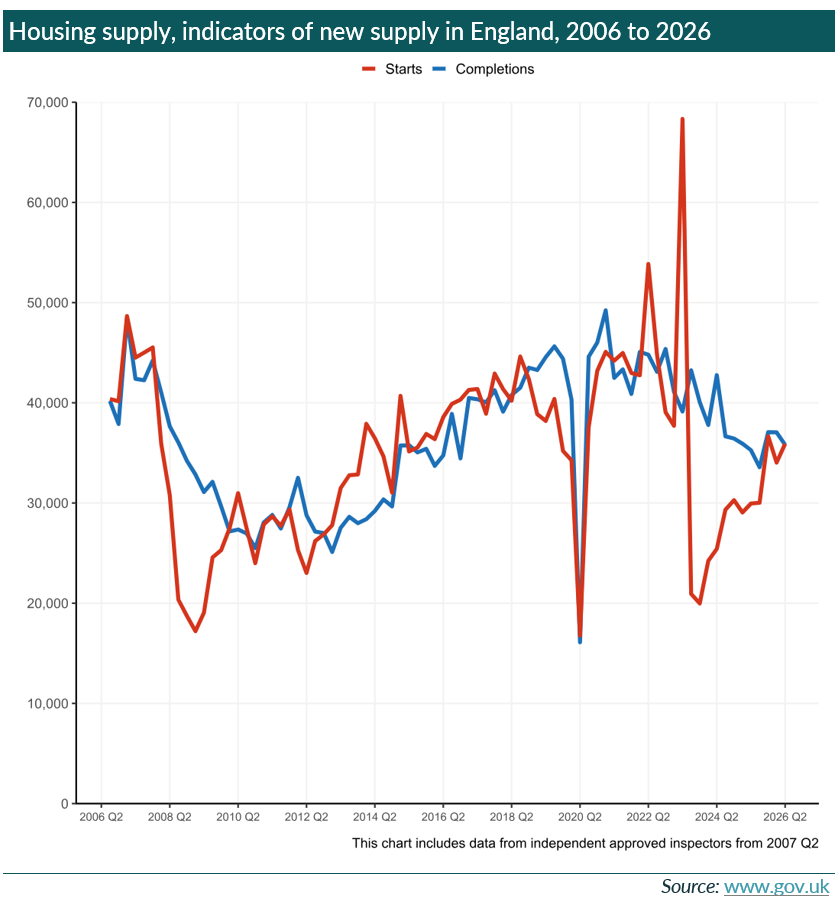
The bar chart, below, published by the Ministry of Housing, Communities and Local Government, highlights the number of housing start-ups and completions in England since 2006: the volatility of the numbers is also pertinent for potential investors.
Despite the demand for new homes, driven in part by immigration, macroeconomic factors remain a potent deterrent for new house buyers. With abiding concerns about the UK economy, notably regarding the £3tr net debt figure and probable tax rises in next month’s Budget, many potential buyers remain cautious. Indeed, many may prefer to rent properties – and forgo the chance, at least for the present, of home ownership.
Of course, future trends in UK interest rates are pivotal in driving sales of new-build houses. Until relatively recently, it was widely expected that interest rates would fall from their current 3.75% level. Instead, at least one and probably more rises are expected unless the Hormuz oil access issue is satisfactorily resolved – or, indeed, oil prices fall. Rising inflation, irrespective of the oil price driver, is also a highly relevant interest rate factor.
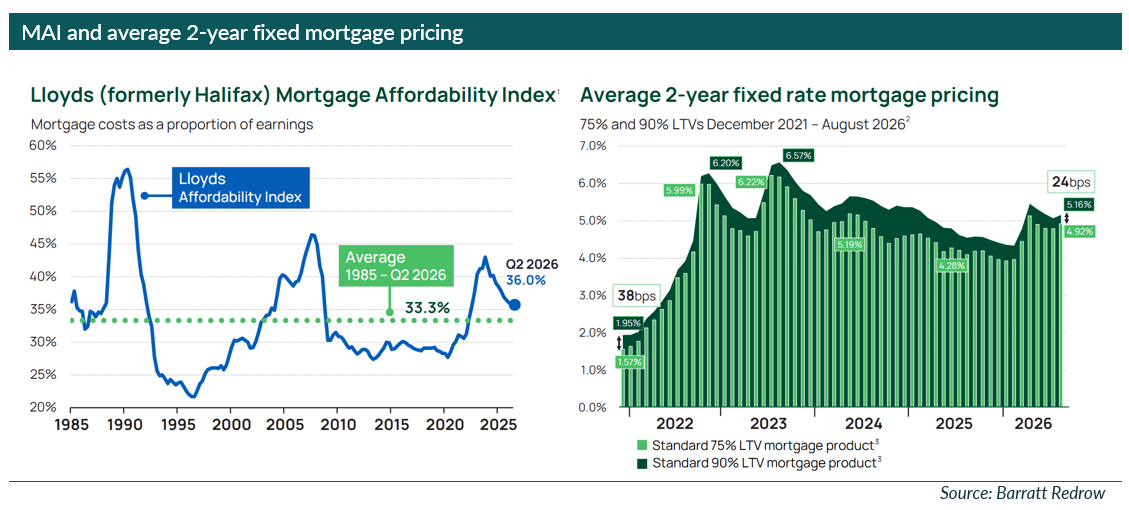
More specifically, the two charts below, published by Barratt Redrow, show the sector Mortgage Availability Index (MAI) data, along with comparable pricing information. Undoubtedly, considerable volatility is in evidence, especially in the sharp increase in the average 2-year fixed mortgage rate from the spring of 2022 to the autumn of 2023 – up from just 2% to more than 6.5% in only 18 months. The MAI calculation is based on i) assessing standardised average housing prices; ii) incorporating average disposable earnings for full-time employees; and iii) using the Bank of England’s monthly average data for new mortgage advances to householders.
Within the sector, housebuilding inflation remains an issue. The latest figures published by Barratt Redrow are projecting a Building Construction Index (BCI) figure of between 3% and 4% for materials and a 2% to 3% for labour: the cost base is split broadly 60%:40%, with the higher percentage being materials-related.
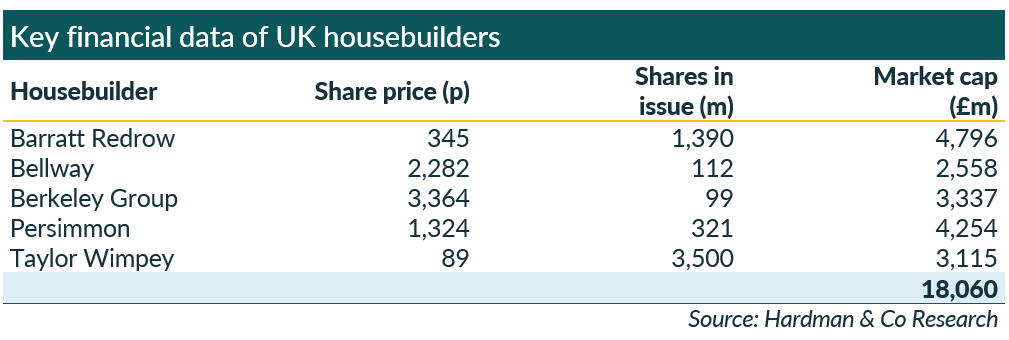
In the UK housebuilding sector, five quoted companies – Barratt Redrow, Persimmon, Berkeley Group, Taylor Wimpey and Bellway – are key.
In total, the current market capitalisation of these five stocks amounts to £18bn, with Barratt Redrow being the most valuable of the quintet at £4.8bn. The table below lists the key valuation data.
Compared with many quoted sectors, the leading UK housebuilders are very UK-centric. To be sure, Taylor Wimpey has some operations in Spain and modest sales in Gibraltar. But the days of substantial investment overseas, harking back to Barratt’s US portfolio in California, which was sold in 2004, seem to be gone.
Berkeley Group, however, does offer a major variation, with its emphasis on urban development, especially in London, where it has successfully undertaken several substantial projects. In terms of overseas activities, Berkeley Group has several offices, mainly in the Far East, to market and sell its UK properties. Furthermore, the smaller Vistry, which emanated from Bovis Homes, is heavily involved in affordable housing schemes, which – to date – have neither boosted its finances nor its share price.
Overall, in terms of sector comparators, Persimmon probably offers the best commentary on the state of the UK housing market. It has ridden the ups-and-downs of the UK housebuilding sector over the past decade.
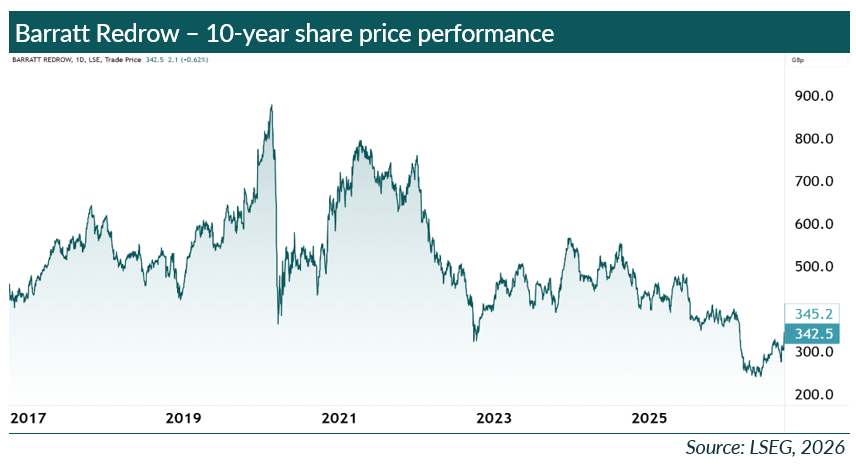
Barratt Redrow, though, remains the most valuable company in the sector – all the more so, with its share-based Redrow acquisition. Highlighted, below, is Barratt Redrow’s share price performance over the past decade; it shows a major decline in the early 2020s as sector confidence was badly eroded on the back of both higher interest rates and reduced build-out figures.
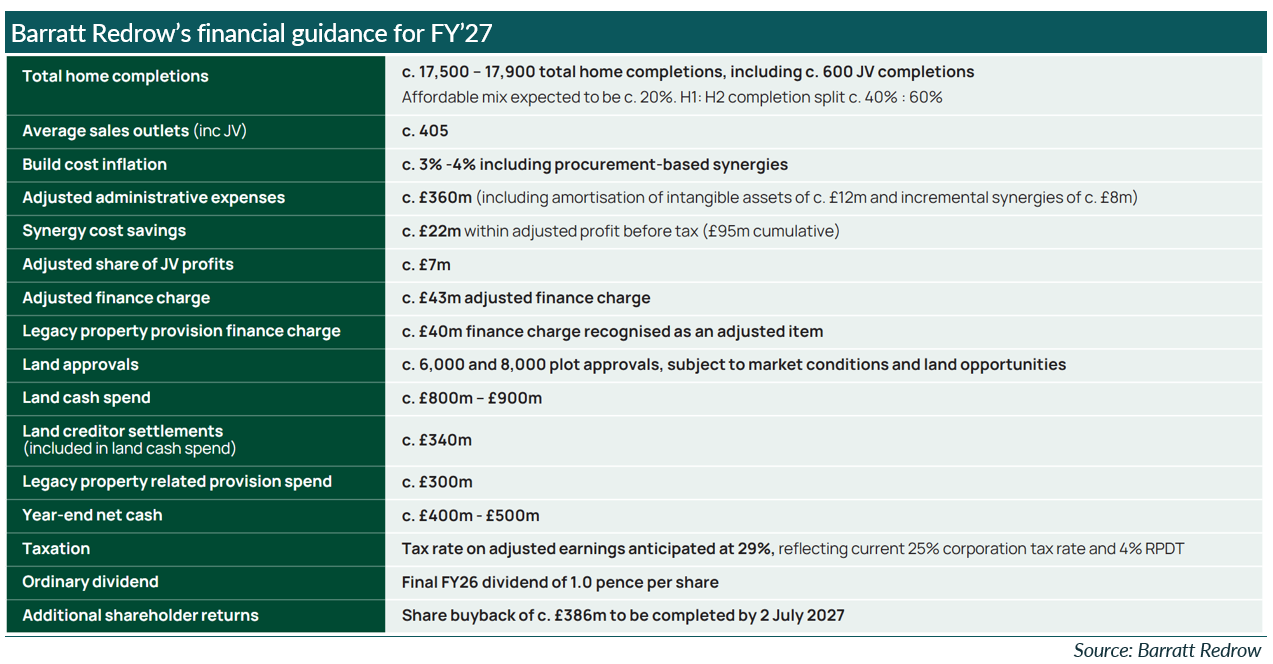
Recently, Barratt Redrow published key financial guidance data for its 2027 Financial Year. The projections suggest some regained stability, with Redrow now effectively integrated: most of its key numbers are seemingly moving in the right direction, although raising operating margins remains a priority. Of course, a sharp rise in interest rates, perhaps to fend off a £ sterling crisis or to respond to rising long-term gilt yields, could reverse this relatively optimistic picture.
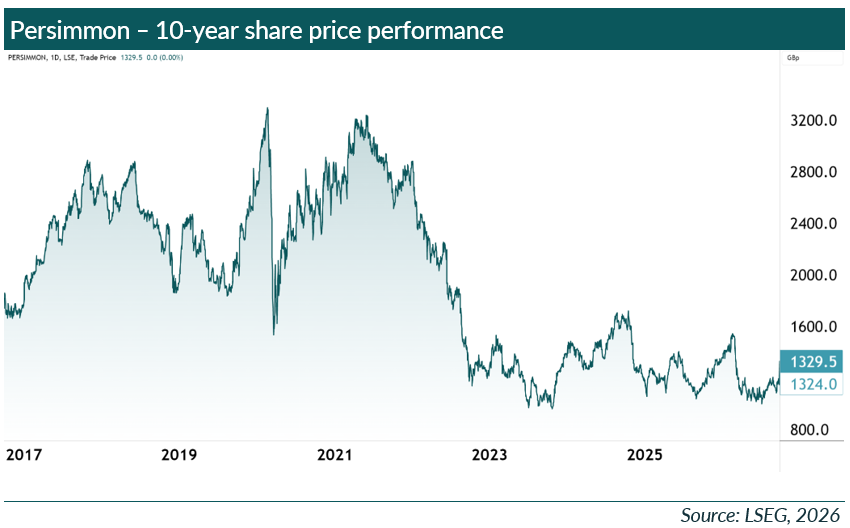
Over the past decade, Persimmon’s fortunes have waxed and waned as the 10-year share price graph, highlighted below, demonstrates. Both macroeconomic factors, such as mortgage rates, and sector-specific issues, such as the volume of housebuilding completions and low operating margins, have been key.
Persimmon’s five-year key financial data illustrates the volatility that it has faced. Between 2022 and 2023, its housebuilding completions fell from 14,868 units to 9,922 units – a YoY fall of no less than a third. Inevitably, as the table below shows, this fed through to other key financial figures.
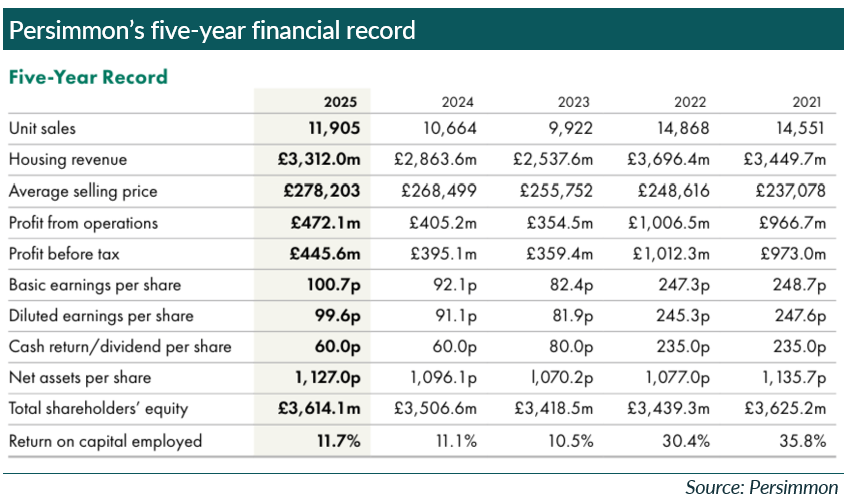
Reassuringly for investors, though, Persimmon has indicated a 12,500-unit completion target for 2026.
The sector’s outperformer in recent years, Berkeley Group, has adjusted more effectively than its peers to changing trends. To be sure, its London and south-east England base has been a boon, despite ongoing pessimism about the former’s house valuation data.
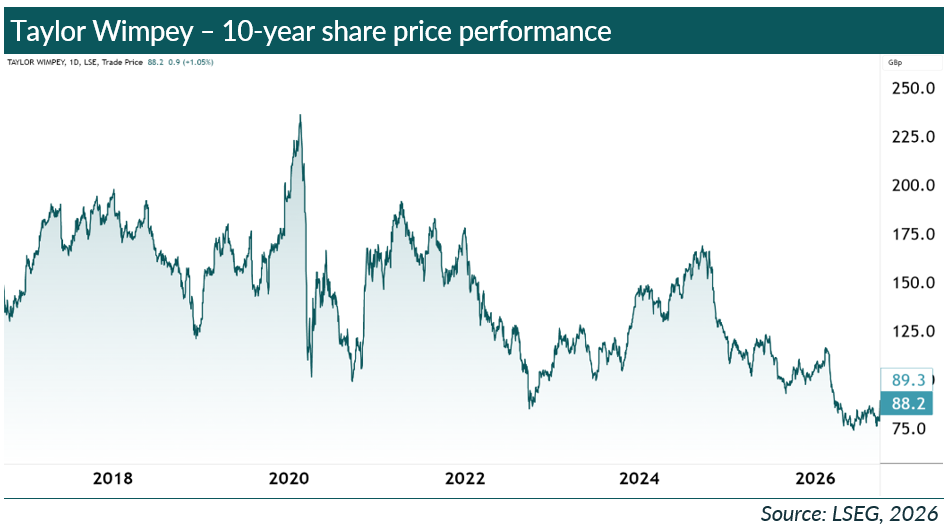
Over the years, Taylor Wimpey’s share price performance has been volatile, to say the least. Unquestionably, the nadir was in late November 2008, when the share price plummeted to below 10p. As such, the survival of Taylor Wimpey – as an operating, and independent entity – was far from certain. It did survive but, understandably, caution has become more ingrained in its decision-making.
Shown below is Taylor Wimpey’s 10-year share price graph, which – albeit uninspiring – has demonstrated a pronounced recovery from its dark days almost 20 years ago.
From its Newcastle base, Bellway has expanded, despite the pronounced financial impact of the COVID-19 downturn. Consequently, between 2021 and 2025, unit sales fell from 10,138 to 8,749 and the average selling price rose from £306,000 to just £316,00 over the four-year period. However, the most serious damage was inflicted by underlying operating margins – down from 18.5% in 2022 to only 10.5% by early 2026.
Vistry’s sharp de-rating has accelerated from the spring of 2024, as abiding concerns about its finances deepened; overall, its shares are down by 77% over the past five years. Its latest 2025/26 half-year results showed a substantial £661m loss, although £475m of this figure was accounted for by goodwill written off from previous acquisitions. Importantly, though, it re-confirmed that it has been awarded a much-needed grant of up to £350m via the Social and Affordability Homes Programme (SAHP). Final details about this capital injection remain outstanding.
Crest Nicholson, whose shares have plummeted in recent years, faces serious financial issues as it seeks to complete its debt covenant renegotiations. The over-riding priority now is – in its own words – to “preserve liquidity, reduce capital intensity and strengthen operational discipline”.
In recent years, UK housebuilders, generally, have preferred to undertake major share buybacks rather than boosting dividends. In some cases, they have built up large cash surpluses and many core shareholders, for varying reasons – some of which are tax-related – prefer the share buyback route to distribute surplus cash, which should boost earnings per share.
Hence, there is no comparable ready-reckoner sector dividend yield as existed for many years in the utilities sector, where quoted prices of individual stocks were beholden to relative yields.
Barratt Redrow has been very explicit in this respect. A major shareholders’ distribution will cost £400m, of which £386m will be directed into the share buyback programme, while a paltry £14m has been earmarked for a modest 1p per share dividend.
Persimmon has followed a somewhat different path, having undertaken major shareholder payouts in 2021 and 2022. Its latest dividend has been held at 20p per share and further funds will be used to replenish the land bank.
Taylor Wimpey has partly emulated Barratt Redrow, although – with caution – as it moves gradually towards fully embracing its share buyback policy.
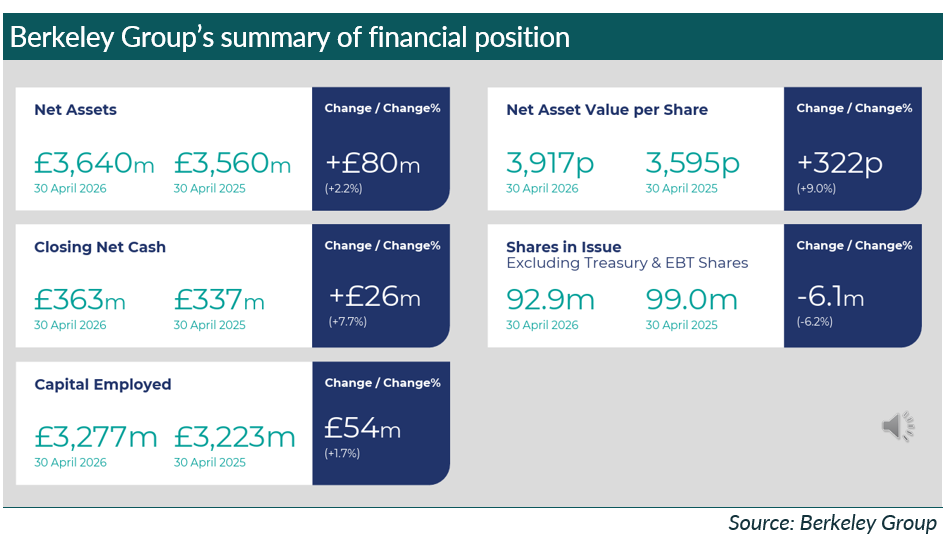
Berkeley Group, which has performed well – and certainly when compared with its housebuilding peers in recent years – has set an ambitious target of achieving £528m of share buybacks between May 2026 and September 2030.
Its finances are underpinned by its robust balance sheet, the key details of which are set out below:
Bellway, too, is adopting the share buyback model, following its launch in October 2025, when a relatively modest £150m was allocated.
In terms of P/E ratios, the latest data for the leading quintet show a ratio of between 11x and 13x, a relatively low level given the general strength of their balance sheets – but equally reflective of current economic uncertainties.
Not surprisingly, two more lowly valued UK housebuilders, Vistry and Crest Nicholson, are currently trading on far lower P/Es. Both face a raft of financial challenges.
With the considerable uncertainty attached to future interest rate movements – upwards is more likely – the sector outlook is not obviously promising. Nevertheless, the underlying financial figures remain robust, with – in many cases – strong balance sheets being offered: such comments exclude Vistry and Crest Nicholson.
Some reassurance, too, will be provided by the comment of Dean Finch, Chief Executive of Persimmon: “Market conditions remain challenging, with affordability and build-cost pressures affecting the sector”. Even so, Persimmon is projecting some 12,500 completions for the 2026 Financial Year, compared with 11,905 in 2025 and just 9,922 in the dark days of 2023. Nevertheless, on the supply side, building cost inflation remains a challenge.
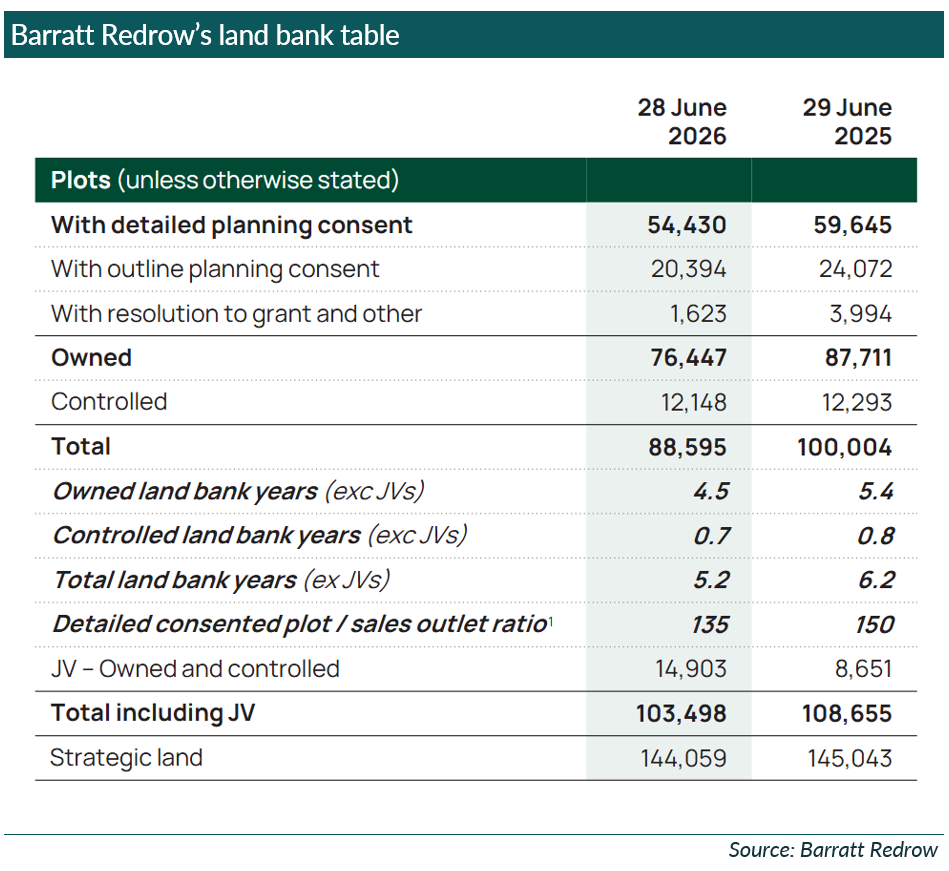
With the downturn of a few years ago, land bank numbers are favourable, with Persimmon holding around 84,000 plots. Meanwhile, Barratt Redrow published its latest land bank table, which confirmed positive figures – both operationally and financially – as set out below.
For some years, volatility has been a central feature of the UK housebuilding sector, caused mainly by the sharp post-COVID 19 increases in interest rates. As such, caution has prevailed, which partly explains the current balance sheet strength of the leading companies.
The successful annual formula of the pre-2023 era – build more units, deliver higher prices per unit, increase the dividend and watch the share price rise – is no longer quite so credible. Hence, strategic changes have been called for – and have been successfully pursued by Berkeley Group.
And don’t overstretch yourself – the lesson from Taylor Wimpey’s near terminal woes in 2008 still applies.
Nigel Hawkins is the Infrastructure and Renewables Specialist at Hardman & Co.
Nigel specialises in the energy sector, with a particular focus on the expanding renewable generation market, both in the UK and overseas, about which he has written several reports assessing the sector’s finances. He has been involved in analysing the utilities sector since the 1980s. He covered the privatisation of the water and electricity companies for Hoare Govett between 1989 and 1995. Subsequently, he researched the UK and EU telecoms sector for Williams de Broe.
He has also written many feature articles for Utility Week magazine since the mid-1990s. Between 1984 and 1987, Nigel was the Political Correspondence Secretary to Lady Thatcher at 10 Downing Street. Nigel joined Hardman & Co in February 2016. He holds a BA (Hons) in Law, Economics and Politics from the University of Buckingham, and is a senior fellow of the Adam Smith Institute.