×

Ranked at number 4 in FeedSpot Podcasts for '10 Best Venture Capital Podcasts UK Edition 2026' -

Leading podcast in EIS

2025 Pharma Statistics

08 Apr 2026 / Corporate research

Underlying 5.4% growth, boosted by forex

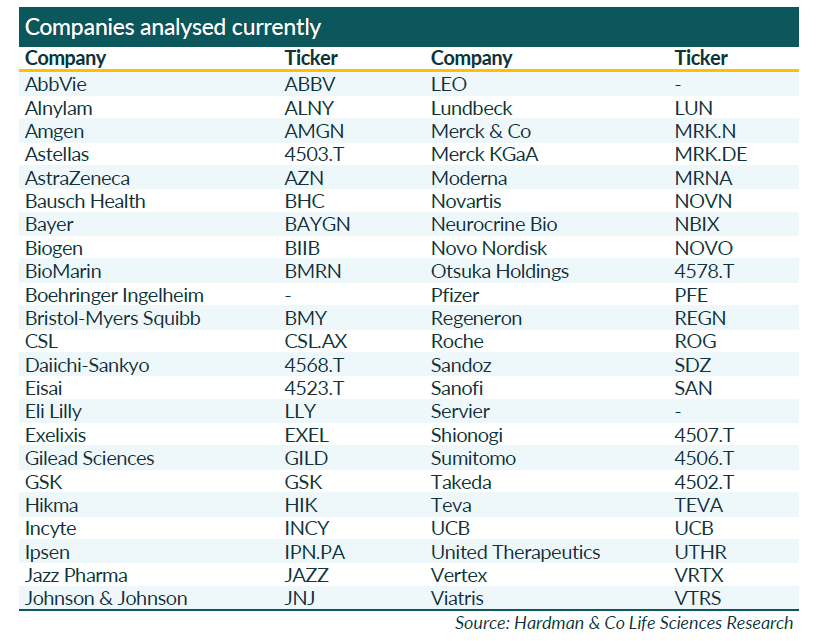
Our pharmaceutical dataset has been compiled over 40 years from 109 companies, which, through M&A activity and consolidation, now comprises 46 companies. An efficient reporting system has seen all the listed multinational pharma companies announce results for 2025, giving us the opportunity to update our industry statistics and drug database. This report provides the first snapshot of global pharmaceutical market growth plus the global and US company rankings for 2025. The year was characterised by 5.4% underlying (ex-COVID-19) growth, boosted at the reported level by $ weakness. Much of the growth was driven by recently launched anti-obesity drugs, which have propelled Eli Lilly to be the top-ranked company globally. R&D spend breached $200bn for the first time, but, for the second year running, there has been a reduction in spend relative to pharma sales.

  • Global market: Hardman & Co estimates that the underlying global prescription drug (Rx) market grew 5.4% in 2025, to $1,188bn, from $1,127bn in 2024. Reported growth, including the ever-declining COVID-19 product and therapies and a significant forex boost, was 7.3% to $1,225bn ($1,142bn).
  • US market: Once again, the main driver of global growth was the US market, with underlying growth of 8.9% in 2025, to $553bn, from $508bn in 2024, with an increased contribution to the global market of 46.5% (underlying basis; 45.6% reported basis). In 2025, the US FDA approved only 50 new chemical entities (NCEs) and biologics, down from 63 in 2024.
  • GLP-1 analogues: A key driver to global pharma growth has been the exceptional performance of GLP-1 analogues for obesity and diabetes. Sales of these drugs grew 46% to $75.8bn in 2025, from $51.8bn in 2024. Mounjaro/Zepbound (Eli Lilly), with 48% market share, overtook Ozempic/ Wegovy (Novo Nordisk). While prices are under severe pressure, volume growth and demand are expected to continue, especially with the first approval of an oral version, but this makes forecasting in 2026 more difficult.
  • Oncology: Drugs to treat cancer are perceived as an important growth driver. However, our preliminary analysis shows the rate of sales growth slowed to 5.4% to $240bn, in 2025. This figure was also boosted by the weakness in the $. The patient population – new patients minus deaths, drug efficacy, approval rates and loss of patent protection were all contributory factors.
  • Gene therapies: This summary also includes a first assessment of the commercialisation of gene therapies. They came to the market with high expectations for rare diseases. Sales in 2025 were just over $7.0bn, but our analysis suggests that 75% of the approvals have been commercial failures.
  • Best-selling drugs: The rapid rise of obesity drugs has seen Mounjaro/Zepbound become the world’s top-selling drug in 2025, with sales of $36.5bn. It has overtaken Keytruda (Merck & Co; melanoma), which grew 7.5% to $31.7bn. Close behind, in third place, was Ozempic/Wegovy, with sales of $31.2bn. The top 10 drugs had global sales of $198.4bn in 2025, representing 16.3% of the entire market, up from $143.3bn in 2024 (12.7% of market).
  • R&D investment: The top 20 drug companies, by sales, reinvested 21.3% (22.5%) of Rx drug sales back into new drug development, spending $172bn ($167bn) out of the total spend of $201bn by the 46 largest companies. The average spend was $8.6bn, ranging from $15.8bn (Merck & Co) to $3.2bn (Daiichi-Sankyo).

Download the full report

Request a meeting

If you'd like to be introduced to the team at , get in touch.

Request a meeting
Download the full report