
This report is provided for informational purposes only and should not be interpreted as providing investment advice nor making recommendations to readers.
UK tech stocks continue to find support at around COVID-19 pandemic-level lows, following the ruthless five-year bear market. Indeed, large cap software & services stocks have rebounded by ca.40% over the past five months, while tech hardware remains in focus following the global semi-conductor boom.
While the advancement of large language models (LLMs), combined with massive data centre investment, generated fears of reduced barriers to entry across the software industry, the reality is more complicated, as LLM tokens add a new cost line, and AI advancements add an entirely new level of complexity to business.
Meanwhile, our preferred investment strategy is to focus on potential recovery stocks with attractive valuations while staying clear of hyped-up stocks.
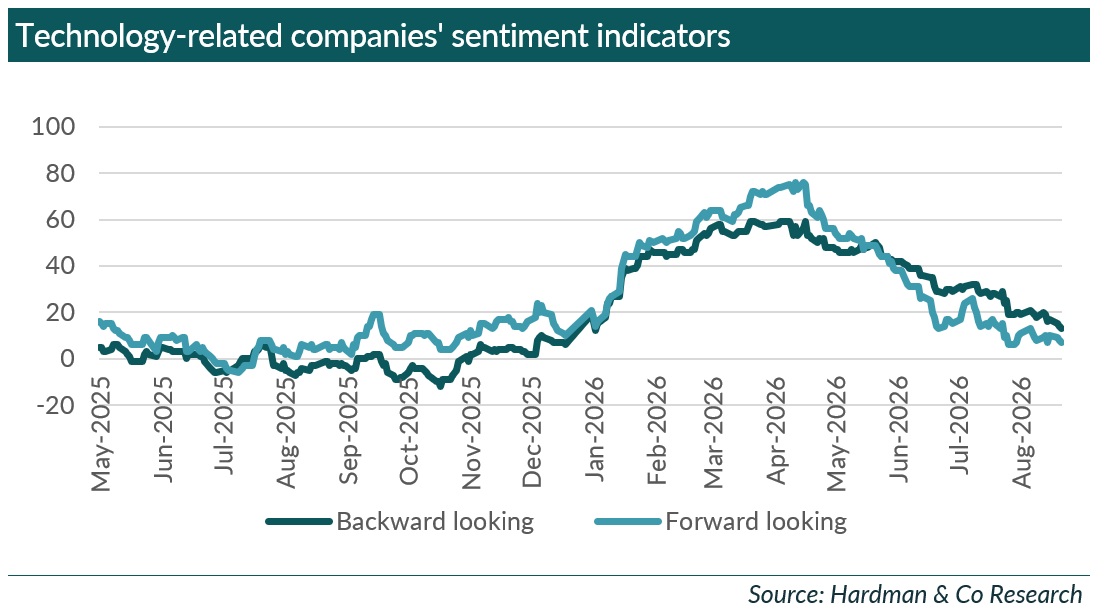
Trading updates continue to be positive, albeit at significantly lower levels than we saw in January through to April this year. This is in spite of the ongoing challenging economic and geopolitical backdrop. Going forward, the question is: can the market generate a similar typical strong first quarter as we move into 2027?
We continue to monitor trading updates and earnings announcements of UK tech-related stocks of all sizes, the vast majority of which are small caps. For the purpose of this analysis, our universe is broadly defined and includes IP-driven business across a range of sectors (excluding drug discovery). We monitored 43 companies’ statements over August, and ‒ based on commentary (including profit beats/misses, as well as new business wins and outlook statements) ‒ we estimate that ca.40% of these announcements resulted in improvements to the outlook for the individual businesses, compared with 26% that saw decreases.
We quantify these data, as shown in the graph below. On a trading or results announcement, we allocate a +1 for a beat and a -1 for a miss, with a similar process for the perceived outlook. The numbers are aggregated on a quarterly rolling basis, since many companies release trading news each quarter.
While the advancement of LLMs, combined with massive data centre investment, generated fears of reduced barriers to entry in the software industry, and the subsequent “SaaSpocalyse” sell-off in February, the reality is proving far more complicated. LLM tokens add a new cost line while AI advances effectively have added an entirely new level of complexity to businesses since it increases the number of things that management has to control. There is a plethora of models to choose from, ranging from open source to frontier models, with new models popping up and pricing always evolving. This means corporate governance becomes more of an issue as businesses need to have the appropriate systems and controls in place.
As discussed on page 3, recent trading news has remained generally positive. Recent notable outlook improvements, on our assessments, came from Kainos, Petards, CML Microsystems and Seeing Machines while downgrades were generated by Iforex, Synectics, GB Group and Entain. Kainos is up ca.75% since its low-point in March as the business has shrugged off concerns around a “SaaSpocalyse”.
Of the companies in our software & services indices, two thirds of the constituents have a net cash position. Further, all companies are EBITDA-positive on year 2, where consensus data are available, with just one small cap loss-making in year 1.
Underlying growth drivers remain in place with the UK software and computer services sector, propelled by a combination of digitalisation, AI adoption, cloud transformation, regulatory pressures and global demand. Industry analysts continue to forecast high single- to low double-digit growth in global IT spending this year.
We continue to see takeovers while the IPO market remains effectively shut, and secondary fundraisings remain sporadic. Recent software sector takeovers include IDOX, Pinewood and Cordel. In industrial tech, Senior and Gooch & Housego have succumbed to bids, which follows the completion of takeovers of Spectris and Alphawave IP late last year. This shrinking equity supply dynamic continues to remain favourable for the bulls.
We look for companies on modest ratings, healthy balance sheets and with strong growth prospects. We prefer to look at EV/EBITDA and the Rule of 40 test (growth plus EBITDA margin is a good overall assessment of the opportunity).
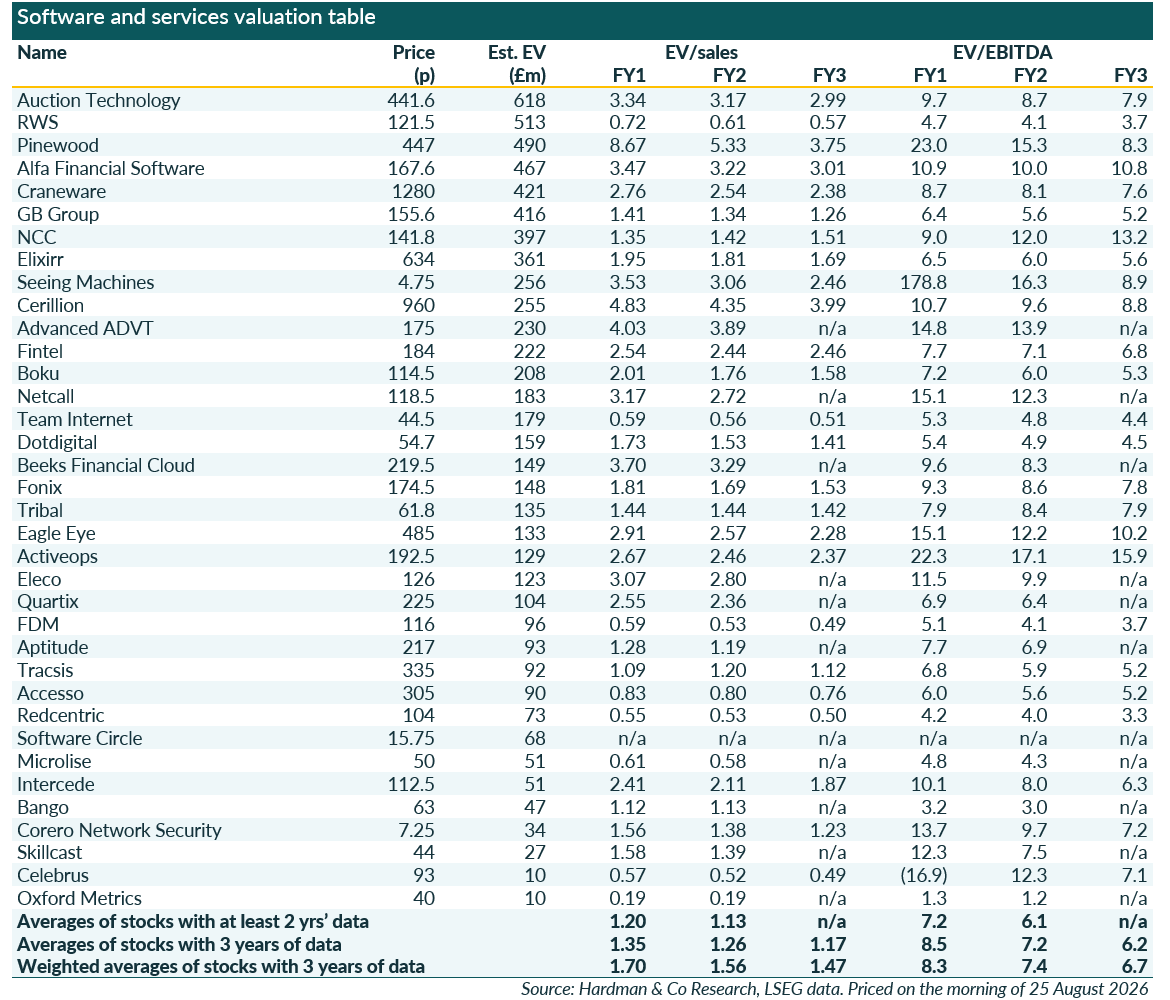
The small cap space remains modestly valued, with ca.40% of the software and service companies in the selection trading at less than 7x EBITDA in the second year (see table on page 7) while three quarters of the companies have a net cash balance sheet. Seven of the companies ‒ Pinewood (taken over), Cerillion, Seeing Machines, Auction Technology, Intercede, Boku and Dotdigital ‒ pass our simple Rule of 40 test, based on the three years of consensus data.
We look closely at potential recovery situations – stocks on attractive ratings that have been overlooked by the market – while staying clear of hyped-up stocks. TPXimpact is a great example of a recovery success story – management has evolved from an acquisition-driven strategy to focusing on driving organic growth.
Soaring investment in AI infrastructure, including data centres, led to a sell-off of Software-as-a-Service companies in February. This sell-off, referred to as the SaaSpocalypse, was due to the concerns that the heavy AI investment would lead to disruptions across the software sector as the AI advancements were making coding so much easier. However, the technology advancements also bring significant new complexities, including far greater volumes of code, as well as a shift to agentic systems. Consequently, security changes fundamentally and data governance becomes much harder.
Meanwhile, the transition of the major LLM vendors ‒ OpenAI, Anthropic and Microsoft ‒ to usage-based revenue models resulted in soaring LLM token spends by corporates. In May, Uber Technologies, the ride booking platform, said that it had spent its entire AI budget in the first four months of the year. This generated speculation that some companies might have spent their entire 2026 AI budget in the first quarter. Consequently, some companies imposed token spending limits on employees, and this also inspired a shift to opensource and cheaper models. The AI inference cost peaked in late May and has broadly halved since then.
This episode highlights the importance of corporate governance. Companies need to determine what systems and controls, such as spending limits, classification systems or model routers, they need to have in place to manage their LLM usage. Interestingly, Stripe acquired OpenRouter in August. OpenRouter provides a common API through which the customer can access hundreds of models and corporate governance tools that include provider restrictions, zero-data-retention routing, price limits and geographic routing.
There are strong indications that the AI revolution has been generating productivity improvements among large caps. Microsoft’s employee numbers, including engineers, have been in decline in recent years, while Salesforce’s engineers have flatlined and SAP employee numbers have significantly lagged revenue growth. Small cap software companies have also been shedding software engineers, but there is strong demand for engineers with AI skills, and they command markedly higher salaries.
UK SaaS company Pinewood Technologies saw an approach in late January. However, the predator, Apax, stepped aside due to the SaaSpocalypse. A new bidder – Ridgeview – turned up over the summer, once the markets had stabilised and there was greater clarity on the evolving AI backdrop. Pinewood has agreed to Ridgeview’s offer of 448p, which is ca.10% below the indicated offer by Apax in January.
Kainos, the UK technology services group, released a strong update in August, upgrading its outlook for FY’27. The group saw momentum across all three of its operating divisions, including its two Workday-focused units. Nasdaq-listed Workday has been in takeover talks with Silver Lake, and this is another indication that the SaaSpocalypse has been overstated. Salesforce shares jumped following its 2Q results in late August, which revealed that its AI products were gaining traction, providing a further indication that the SaaSpocalypse has been overstated.
In May, AIM-listed Cordel agreed to a bid by Vossloh, the German transport-technology group, at a 107% premium, highlighting the extreme undervaluation of some quoted growth companies. The acquisition was completed in August. Cordel is focused on providing AI solutions to the rail industry.
We follow equal-weighted indices of 15 large cap and 36 small cap UK software services companies and compare these indices with an equal-weighted section of 10 UK mega caps. The latter acts as a useful proxy for the broader weighted index.
Both small and large software & services indices follow a similar pattern. After slumping with the broader markets when COVID-19 hit in early 2020, software and services stocks were swept up as the economy was flooded with liquidity, substantially outperforming the broader markets. Both indices peaked in September 2021 but, subsequently, fell back when inflation hit and rates were tightened.
While large cap software & services stocks have jumped by ca.40% over the past five months, it is a small recovery since the peak in 2021. Technology service companies Computacenter, Softcat, Kainos and Bytes have led the rally and Computacenter has joined the FTSE-100 blue chip index. Our large cap index constituents have changed dramatically over recent years, as many of the major UK software businesses, such as Aveva, Avast, Microfocus and Blue Prism, have been taken over.
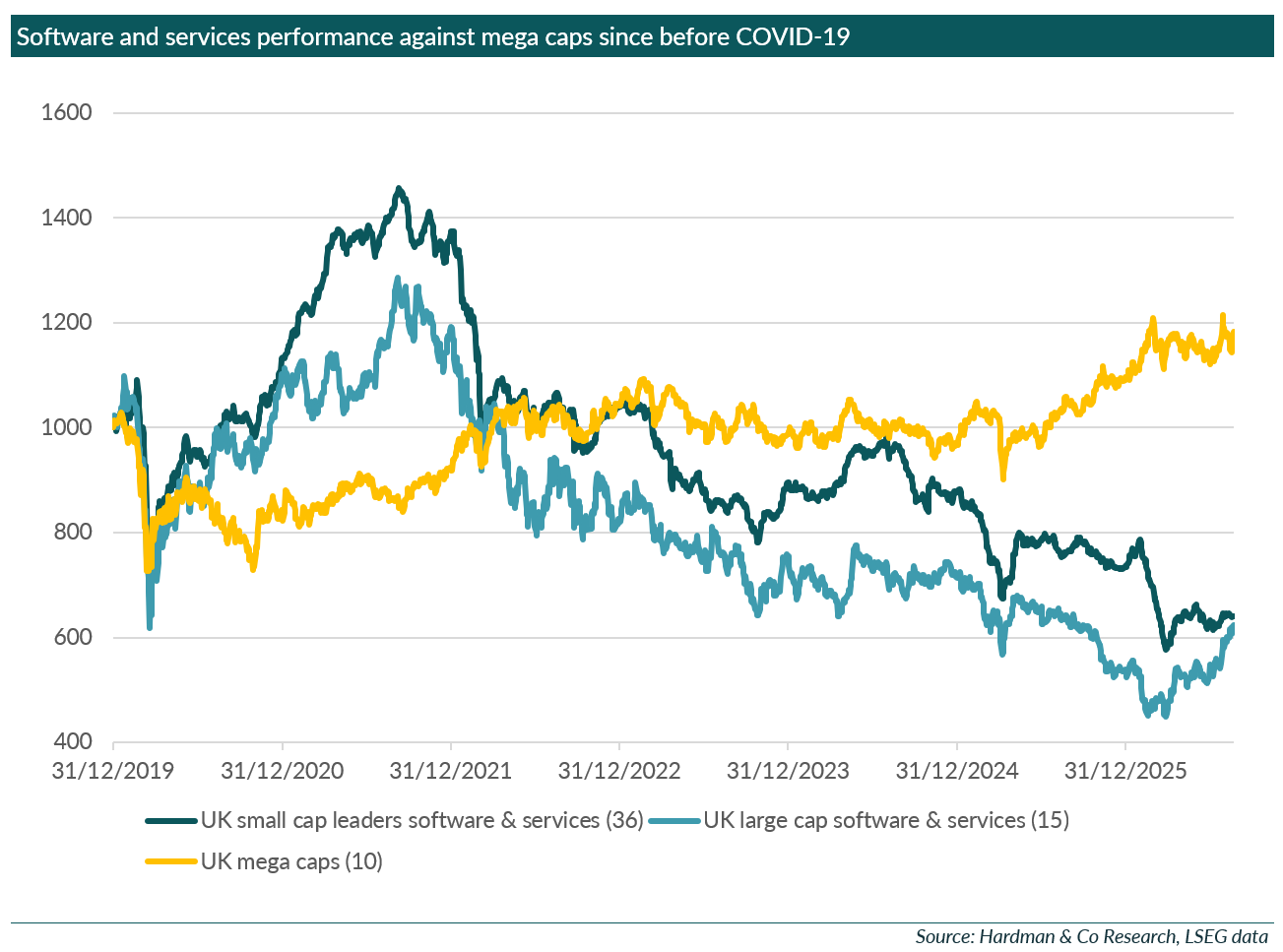
The small cap index remains at roughly half its September 2021 peak, and hovering around the pandemic lows, and showing signs of stabilising. In our view, this could provide a reason for more opportunistic investors to consider investments in the sector.
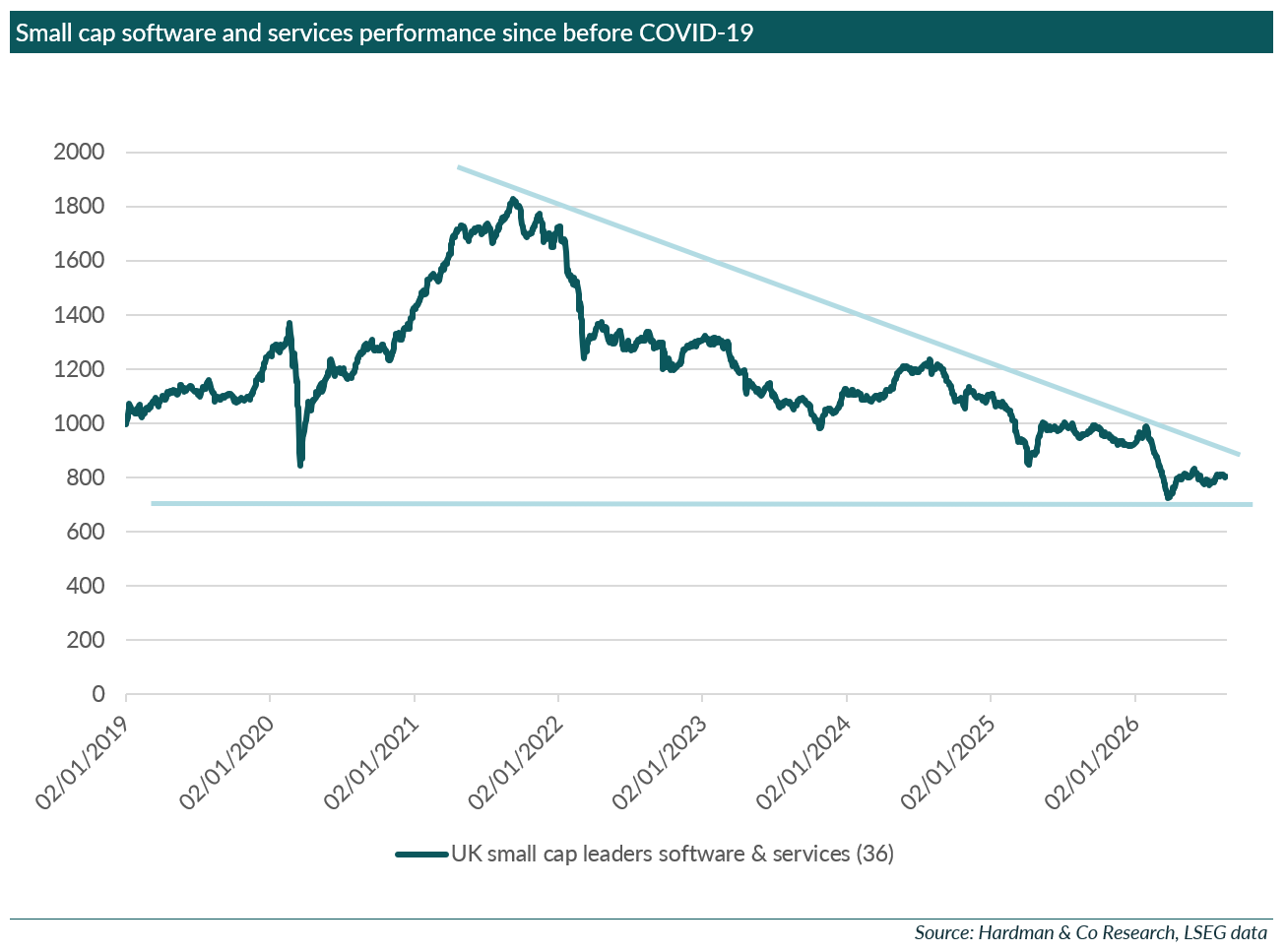
We have constructed a simple valuation table (see page 11) of 36 small cap software and services companies. Although we monitor the broader technology sector, this analysis focuses on software and services companies to ensure there is comparability, while excluding hardware and other disparate technology-related businesses. For simplicity, we have used the consensus forecast balance sheet position as at the end of the first financial year (mostly 31 December 2026) to estimate the enterprise value.
UK larger cap software and services companies, on average, have significantly higher ratings than the small caps, with FY3 EV/EBITDA of 8.3x, compared with 6.2x for the small caps. Further, the compound revenue growth and margin expansion are more modest, at 7.2% and 50bp, respectively, over this two-year period.
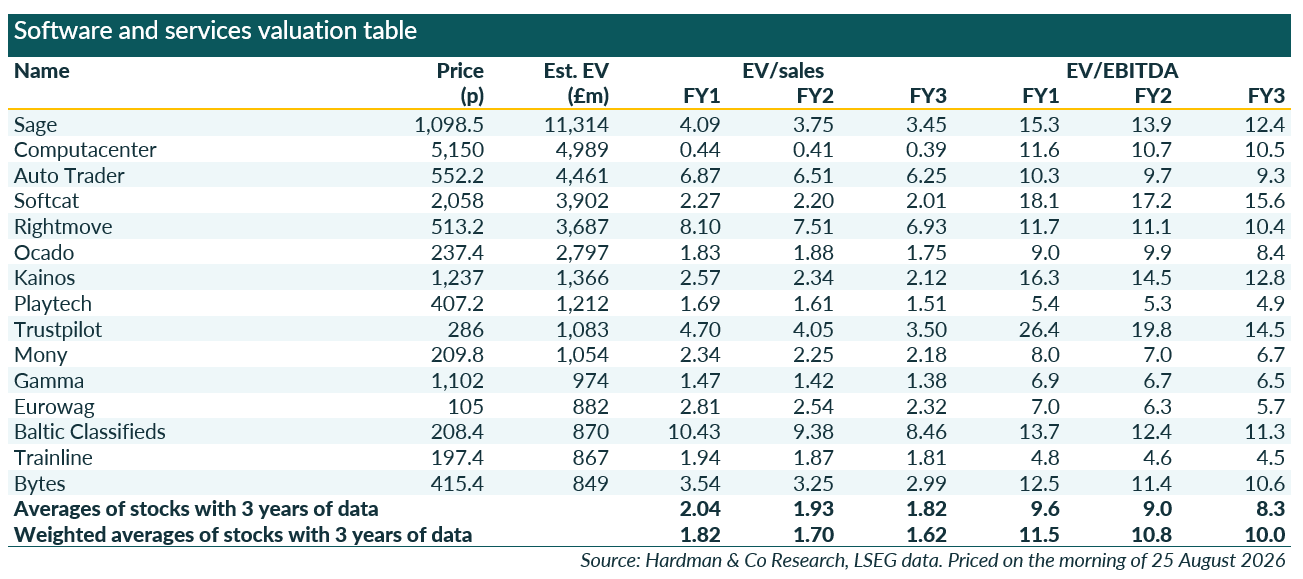
Small caps ratings have fallen substantially since our note in March. Focusing on averages of stocks with three years of data, the EV/revenue is 1.35x in FY1, falling to 1.26x in FY2 and 1.17x in FY3, while EV/EBITDA falls from 8.5x to 6.2x over the same period. This equates to ca.9.4% compound revenue growth over the two-year period and a ca.290bp increase in the average EBITDA margins.
While AI-disruption fears have abated and larger cap software and services companies have rallied in recent months, small caps remain modestly rated. We continue to suggest that investors should focus on stocks with healthy balance sheets and attractive valuation metrics. Stocks that pass the Rule of 40 test and have strong financial position warrant a more serious consideration.
In summary, we highlight the following points supporting the investment case for UK technology stocks:
Richard Jeans is an equity analyst at Hardman & Co, covering the technology sector.
Richard has worked in the investment research industry and financial media for over 35 years. He has covered small cap technology stocks from across the globe for more than 15 years. He has built up a strong knowledge of the global capital markets, having worked on the capital markets desk at the Financial Times. Prior to that, he worked at an independent equity research company in the early 1990s. Brought up in New Zealand, his first job involved compiling the stock market data for New Zealand’s largest newspaper.
Richard joined Hardman & Co in 2023. He is an ASIP, and has been a member of the CFA Institute and its predecessor organisations since 1990.